The Fed raises its target range after six consecutive cuts
 Edward Nguyen
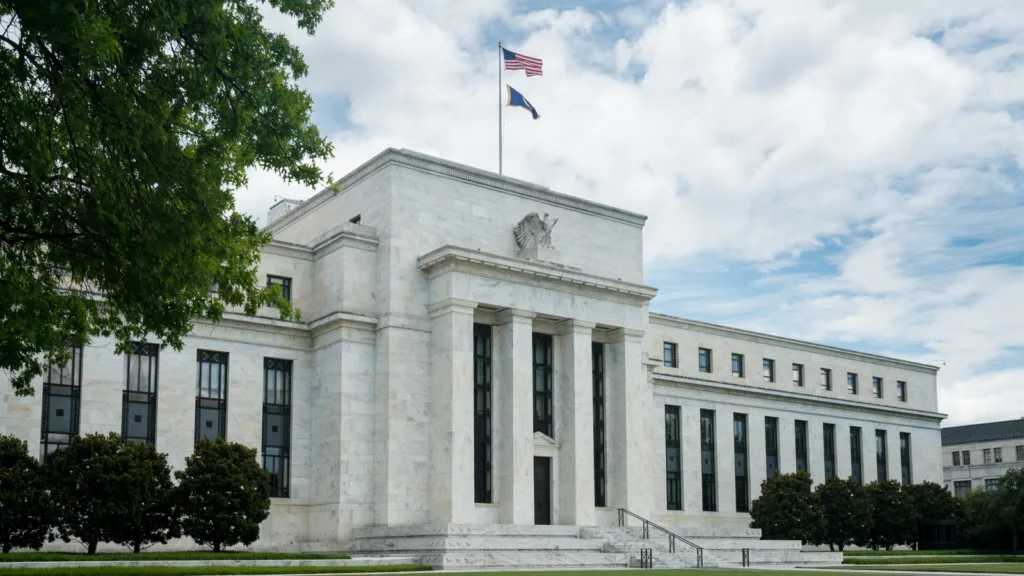
The Federal Reserve headquarters building in Washington. Stock photograph.
A 12–0 vote lifted the range to 3.75–4.00 percent and the projected rate path moved up wherever the two sets can be compared; where global capital goes next is not something the documents read here establish.
The Federal Open Market Committee raised the target range for the federal funds rate on 16 September 2026, by a quarter point, to 3-3/4 to 4 percent. The Federal Reserve dates the change itself to the following day. It is the first increase since 27 July 2023 and the first change of any kind since December 2025. Where capital moves next is not something any document read for this article establishes, and this article does not guess.
What was decided, and the two dates it carries
The Committee approved its statement by a 12–0 vote and put the decision in one sentence: “The Committee decided to raise the target range for the federal funds rate by 1/4 percentage point to 3-3/4 to 4 percent, in support of the Federal Reserve’s dual mandate.” No dissent is recorded.
Two dates attach to that, and they are not interchangeable. The statement is dated 16 September 2026 and was released at 2:00 p.m. EDT. The Federal Reserve’s own table of target-range changes dates the change 17 September 2026, showing an increase of 25 basis points and a level of 3.75–4.00. The first is when the decision was announced; the second is when it took effect.
The Implementation Note, issued the same day and effective 17 September, carries the operating numbers:
- Interest paid on reserve balances raised to 3.90 percent, on a unanimous vote of the Board of Governors.
- Standing overnight repurchase agreement operations at 4.0 percent.
- Standing overnight reverse repurchase agreements offered at 3.75 percent, with a per-counterparty limit of $160 billion per day.
- The primary credit rate raised a quarter point to 4.0 percent, also unanimously, on requests submitted by the boards of seven Reserve Banks — Cleveland, Richmond, Atlanta, Chicago, Minneapolis, Kansas City and Dallas.
The note records which boards asked for that rate. It says nothing about the other five, and nothing should be read into their absence.
One instruction concerns what the Desk buys rather than what the rate is. The Desk is directed, when appropriate, to increase the System Open Market Account’s holdings through purchases of Treasury bills — and, if needed, other Treasury securities with three years or less remaining — to maintain an ample level of reserves. Principal from Treasury holdings is rolled over at auction; principal from agency securities is reinvested into Treasury bills.
The Committee’s remaining meetings this year are on 27–28 October and 8–9 December. The calendar marks the December meeting as one carrying a Summary of Economic Projections.
What the statement stopped saying
The clearest change between July and September is a clause that is no longer there.
On 29 July the Committee wrote: “Inflation remains elevated relative to the Committee’s 2 percent goal, in part reflecting supply shocks that have driven price increases in certain sectors, including energy.”
On 16 September it wrote: “Inflation remains elevated.” The explanation is gone, and the statement adds a sentence July did not carry: “Today’s policy action will support a timelier return to the Committee’s 2 percent goal.”
Two other phrases moved. July described activity as expanding at a solid pace “despite elevated uncertainty that owes, in part, to the conflict in the Middle East”; September has “While uncertainty remains elevated owing, in part, to geopolitical developments, domestic spending has been resilient.” July’s “Productivity growth and capital investment are strong” became “Productivity growth is strong, and capital investment is robust.” One sentence survived both: “The Committee will deliver price stability.”
That establishes how the Committee’s account of inflation is now worded, and no more. The statement does not say why the clause was dropped, and this article does not supply a reason the document withholds.
Unchanged since December 2025, and dissents that changed direction
The range had stood at 3-1/2 to 3-3/4 since the cut announced on 10 December 2025, which the Federal Reserve’s table dates to 11 December. Read in sequence, the seven statements from that meeting to this one record the following.
| Meeting | Decision | Vote and dissents |
|---|---|---|
| 9–10 Dec 2025 | Lower by 1/4, to 3-1/2 – 3-3/4 | Against: Stephen I. Miran, who preferred half a point; Austan D. Goolsbee and Jeffrey R. Schmid, who preferred no change |
| 27–28 Jan 2026 | Maintain | Against: Stephen I. Miran and Christopher J. Waller, both preferring a quarter-point cut |
| 17–18 Mar 2026 | Maintain | Against: Stephen I. Miran, preferring a quarter-point cut |
| 28–29 Apr 2026 | Maintain | Four dissents, in both directions. Stephen I. Miran preferred a cut. Beth M. Hammack, Neel Kashkari and Lorie K. Logan supported maintaining the range but “did not support inclusion of an easing bias in the statement at this time” |
| 16–17 Jun 2026 | Maintain | 12–0 |
| 28–29 Jul 2026 | Maintain | 9–3. Against: Beth M. Hammack, Neel Kashkari and Lorie K. Logan, who preferred to raise by a quarter point |
| 15–16 Sep 2026 | Raise by 1/4, to 3-3/4 – 4 | 12–0 |
At the January and March meetings, every dissent asked for a quarter-point cut. December and April each drew dissents in both directions. In April, Stephen I. Miran preferred a cut, while Beth M. Hammack, Neel Kashkari and Lorie K. Logan supported maintaining the range and objected to the statement’s easing bias rather than to the rate. The same three dissented in July, that time on the rate itself. In September the Committee raised, and nobody dissented.
That is what the consecutive statements record. It is not a finding that those three were proved right, and the documents do not put it that way.
The distance travelled is also on the record. Between the increase dated 27 July 2023, which took the range to 5.25–5.50, and the increase dated 17 September 2026, the Federal Reserve’s table shows six decreases totalling 175 basis points: 50 points in September 2024, then 25 points on each of five occasions through December 2025. The range of 3.75–4.00 set this week is one the Committee last held between 30 October and 11 December 2025, on the way down.
Participants’ projections, and what they are
The Summary of Economic Projections carries its own release line — “For release at 2:00 p.m., EDT, September 16, 2026” — the same hour as the statement. Three things about it have to be settled before its numbers are used.
The rate figures are midpoints. The document states that the federal funds projections are the value of the midpoint of each participant’s projected appropriate target range at the end of the year named. They are not the endpoints of a range.
They are individual, and conditional. Each projection rests on “information available at the time of the meeting” together with that participant’s own assessment of appropriate monetary policy. Appropriate policy is defined as the path each participant separately deems most likely to satisfy the mandate, on his or her own reading of it. Longer-run values are where each variable would converge “under appropriate monetary policy and in the absence of further shocks to the economy.” This is not a decision the Committee has taken and not a path it has undertaken to follow.
The variables did not move together. The federal funds medians rose relative to June at every horizon the two sets share. Unemployment medians fell for 2026, 2027 and 2028, while the longer-run median was unchanged at 4.2. The inflation medians barely moved.
Medians, in percent:
| 2026 | 2027 | 2028 | 2029 | Longer run | |
|---|---|---|---|---|---|
| Federal funds rate — projected target-range midpoint | 4.1 | 4.1 | 3.9 | 3.6 | 3.2 |
| — June projection | 3.8 | 3.6 | 3.4 | no comparator | 3.1 |
| PCE inflation | 3.7 | 2.3 | 2.1 | 2.0 | 2.0 |
| — June projection | 3.6 | 2.3 | 2.0 | no comparator | 2.0 |
| Core PCE inflation | 3.4 | 2.5 | 2.2 | 2.0 | — |
| — June projection | 3.3 | 2.5 | 2.1 | no comparator | — |
| Unemployment rate | 4.1 | 4.1 | 4.1 | 4.1 | 4.2 |
| — June projection | 4.3 | 4.3 | 4.2 | no comparator | 4.2 |
| Change in real GDP | 2.3 | 2.4 | 2.2 | 2.1 | 2.0 |
| — June projection | 2.2 | 2.3 | 2.2 | no comparator | 2.0 |
The June set does not run to 2029, so for that year no comparison exists. Where comparison is possible, the rate medians are three-tenths higher for 2026, half a point higher for 2027 and half a point higher for 2028 — those two are equally the largest revisions — and a tenth higher in the longer run.
Against that, the spread. For 2027 the median is 4.1 percent, while participants’ projections range from 3.1 to 4.4 percent, with a central tendency of 3.6 to 4.4. Both facts are true of the same table, and an account reporting only the median has reported half of it.
For scale against the current setting: the midpoint of the range in force from 17 September is 3.875 percent, and the median for the end of 2026 is 4.1 percent.
What this article does not say
It does not say where capital will go. None of the documents read here answers that. The Committee publishes projections of the rate its participants individually consider appropriate, under conditions the document itself names as assumptions; that is a different object from a forecast of where money moves, and treating one as the other is the error this article is written to avoid.
No exchange rate is used above, and no figure has been converted. The minutes of the 15–16 September meeting had not been published when this was written. The Chair’s press conference was not read. No market data, bond yield or asset price was consulted, and none is reported.
What the documents do support is narrower and more useful than a forecast. A target range unchanged since December 2025, and not raised since July 2023, has been raised; the Committee that held it through those months, over dissents that first asked for cuts and later asked for an increase, moved without opposition; and the published federal funds medians now sit above June’s at every horizon present in both sets. The next two dates on which any of that can change are 27–28 October and 8–9 December.
Read this article in Vietnamese
Sources: Federal Reserve — FOMC statement, 16 September 2026 · Federal Reserve — Implementation Note, 16 September 2026 · Federal Reserve — Summary of Economic Projections, 16 September 2026 (PDF) · Federal Reserve — Target range changes by year · Federal Reserve — FOMC meeting calendars · Federal Reserve — FOMC statement, 29 July 2026
The Legation Times writes its content from published documents; nothing here is legal, tax or investment advice. Spotted an error? Send a correction request; for content rights, send a takedown request.