Nauru’s citizenship programme now calls itself the Naoero Economic and Climate Resilience Citizenship Program
 Edward Nguyen
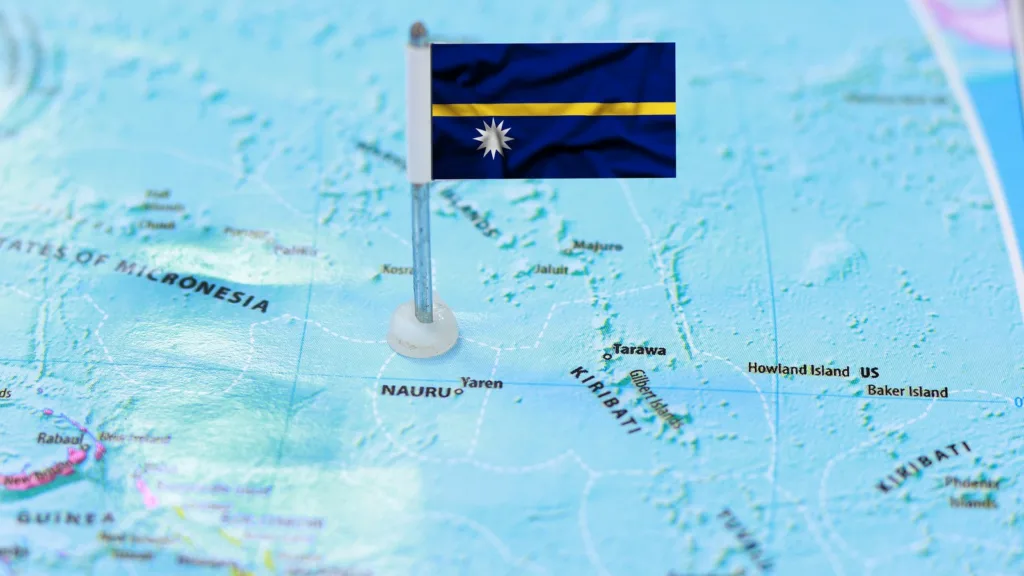
A printed Pacific map labelling the island NAURU and Yaren, photographed on 17 September 2026.
The programme uses the Naoero name on every page read, including its Spanish and French editions. The state instruments call the statute the Nauru Economic and Climate Resilience Citizenship Act 2024, and a regulation requires the citizenship certificate to read Republic of Nauru.
The Government Gazette of the Republic is published by authority, and its masthead is the first line on every issue. On 27 May 2026 that line read REPUBLIC OF NAURU GOVERNMENT GAZETTE. On 28 May 2026 it read REPUBLIC OF NAOERO GOVERNMENT GAZETTE. The two issues are consecutive: No. 184 and No. 185.
No. 185 is routine administration. It carries four notices of promotion made under section 27A(2a) of the Public Service Act 2016 — a negotiation officer moved to land register officer, two firefighters and a meteorological forecaster — each signed by the Chief Secretary and dated 20 May 2026. Nothing in it announces a change in the name of the Republic, and nothing in it accounts for the masthead above it.
The issue published the day before is stranger. No. 184 keeps NAURU on its masthead, but the instrument printed inside it — a presidential assignment of ministerial responsibilities under Article 23 — is headed CONSTITUTION OF NAOERO and signed by the President of THE REPUBLIC OF NAOERO. Both issues also carry a running header at the top of each page, and on both of them that header still ends in the word Nauru.
For most readers this would be a curiosity about a masthead. It is not, because of what a regulation four months earlier says has to be printed on a document people are paying for.
What the certificate is required to say
On 29 January 2026 the Cabinet certified the Nauru Economic and Climate Resilience Citizenship (Amendment) Regulations 2026, No. 2 of 2026, gazetted as G.N. No. 114/2026. They amend the 2024 regulations that run the contribution-based citizenship programme, and one of the things they set out is the form of the certificate a successful applicant receives.
Item 3 of that schedule provides that a Certificate of Citizenship, for the purposes of section 20 of the Act and regulation 19, must include “the words ‘Republic of Nauru’ and a reference to the Nauru Economic and Climate Resilience Citizenship Act 2024”. The declaration the regulations put on the face of the certificate begins “I, [Name of current President] President of the Republic of Nauru hereby declare” and grants citizenship “pursuant to the Nauru Economic and Climate Resilience Citizenship Act 2024”. Across the whole instrument the phrase Republic of Nauru appears four times and Naoero not once.
Nothing found in the 858 issues read amends Item 3 after that date.
The programme’s own website reads the other way. Its About page, opened on 17 September, says the programme was “Established through the Naoero Economic and Climate Resilience Citizenship Act 2024”. On the pages read — home, About and FAQ — the site uses Naoero throughout, Nauru does not appear on the home page at all, and the FAQ speaks of “your Naoero passport”. The programme office’s own social accounts are still registered under the older spelling.
This article is not saying the programme is unlawful or the Act invalid, and it has no basis to say either. What it is saying is narrower and checkable: the regulation prescribing the certificate and the website selling the route do not use the same name, and a person deciding on a contribution is entitled to know which document governs. No passport was seen for this article, so nothing here is a claim about what is printed in one; the certificate of citizenship is a different document, and it is the one the regulation describes.
Two names on one page
The programme calls itself the Naoero Economic and Climate Resilience Citizenship Program, run by the Naoero Program Office. Across eight pages read on 17 September 2026 that spelling is consistent: how-to-apply carries Naoero 22 times and Nauru none, agents 19 and none, contribution 15 and none, terms-policy 12 and none, the home page 29 and none.
Its news page is where the two names sit closest together. The page’s own furniture uses Naoero 13 times; the press headlines the page itself chooses to display use Nauru 18 times. One of them reads “CEO of the Nauru Economic and Climate Resilience Citizenship Program has echoed calls…”; another describes a new citizen arriving on “a Nauru passport”.
The Spanish and French editions have been carried over in full: the Spanish page is titled “Program de Ciudadanía de Naoero”, with Naoero 28 times and Nauru none, and the French “Programme de citoyenneté de Naoero”, 27 and none. The Chinese edition has not: its page title reads 瑙鲁公民身份计划|瑙鲁计划办公室, in which 瑙鲁 is the Chinese name for Nauru, and Naoero survives only inside the untranslated brand string.
The news page carries no announcement of a change of name. It was read in full on 17 September 2026: there is no notice, and none of the words rebrand, renamed, new name or formerly appears on it.
The state kept citing the older title after the masthead changed
An instrument extending the designation of a special project under the programme to 31 December 2026 was made under section 9(7) of the Act following Cabinet Resolution 539/2026 of 3 June 2026, dated 3 June and gazetted on 5 June — six days and eight days after the change respectively. The masthead over it reads REPUBLIC OF NAOERO. The instrument beneath cites the NAURU ECONOMIC AND CLIMATE RESILIENCE CITIZENSHIP ACT 2024 and the Nauru Economic and Climate Resilience Citizenship Regulations 2024, and the word Naoero does not appear in its text.
The same split runs through the statute book. The Administrative Arrangements (No. 2) Order 2026, made by the President on 25 May, lists every written law in force: 206 Act titles, of which thirty-eight carry the word Nauru and seven carry Naoero. It lists the ordinary citizenship law as the Naoero Citizenship Act 2017, the programme’s statute as the Nauru Economic and Climate Resilience Citizenship Act 2024, and the constitution as the Constitution of Nauru 1968. The earliest Naoero titles date from 2017, so the word is not new in Nauruan law; how each Act came by its title is not something the inventory records.
Six amendments certified, none of them printed
The constitution has been through a certification process repeatedly in the past two years, and the gazette records that fact without recording any of the substance.
Between March 2025 and May 2026 the Clerk of Parliament gazetted six notices stating that the Speaker had certified a Constitution (Amendment) Act.
| Act number | Short title | Date certified |
|---|---|---|
| — | Constitution (Amendment) Act 2024 | 11 March 2025 |
| 1 of 2026 | Constitution (Amendment) Act 2025 | 14 January 2026 |
| 8 of 2026 | Constitution (Amendment)(no. 3) Act 2025 | 26 March 2026 |
| 15 of 2026 | Constitution (Amendment) Act 2025 | 31 March 2026 |
| 18 of 2026 | Constitution (Amendment) Act 2026 | 16 April 2026 |
| 21 of 2026 | Constitution (Amendment) (no. 2) Act 2026 | 12 May 2026 |
Each notice gives an Act number, a short title and a date of certification, and nothing else. That holds for all twenty-four certification notices across the two years.
The absence of the texts was tested rather than assumed. Eight independent searches were run across the 858 issues, after first checking on a known case — issue No. 463 of 2025, which does print a statutory instrument in full — that the searches find such a thing when it is there. They do. None of them finds the operative provisions of a constitutional amendment: no enacting formula, no amending clause touching Article 1, no reference to the Fifth Schedule, no text of Part I. A short title is not content, so what any of the six Acts did is not something this article can read, and not something it infers.
When an amendment does reach the voters
What the gazette does record in full is the last time one did.
On 15 August 2025 the President, as Chairperson of Cabinet, gazetted a Referendum Procedures (Article 84) Notice 2025 under the Referendum Procedures Act 2025, fixing the date of an Article 84 referendum on the Constitution (Amendment) Bill 2025 to run alongside that year’s general election. On 2 October the Cabinet made regulations under section 27 of the same Act replacing Form 1 of its schedule with a new BALLOT PAPER – ARTICLE 84 REFERENDUM.
The vote was held on Saturday 11 October 2025, and the certificate of results was gazetted two days later over the signatures of three Electoral Commissioners acting as returning officers. The question was whether the term of Parliament should be increased from three years to four. Of 8,315 valid votes, 3,714 were yes and 4,601 were no — 44.7 per cent in favour, against a threshold of two-thirds. It did not pass, which is why that bill is not among the certified Acts above.
That question needed a referendum because of where it sat. Article 84(2) requires ninety days between introduction and passage and the votes of two-thirds of all members of Parliament. Article 84(3) adds a second gate for anything listed in the Fifth Schedule: two-thirds of all votes validly cast at a referendum. Item (iv) of that Schedule is “clause (7) of Article 41”, the clause fixing the parliamentary term at three years. Item (i) is Part I, headed “The Republic of Nauru and the Supreme Law of Nauru”, which contains Article 1; Article 82(1) provides that the headings of the Parts are themselves part of the constitution.
Across the 858 issues read, the words Article 84 appear in exactly two, both from 2025, and both belong to that parliamentary-term vote. No referendum notice of any kind appears in the 2026 gazettes. That records what is absent from the set that was read and nothing more: since the texts of the six Acts are not published there, the gazette cannot show which provisions any of them reached, and this article draws no conclusion about what procedure was required.
Nauru had held one referendum before 2025, on 27 February 2010, on a bill of Fifth Schedule amendments; Parliament’s own account records 67 per cent against and 33 per cent in favour. That page still calls the 2010 vote the country’s first and has not been updated to record the second. Both fell short of two-thirds.
The constitution as published, in two versions
The Parliament website publishes the text under the heading “Constitution of Naoero”, where Article 1 reads “Naoero is an independent republic”. The PDF that the same page links to as its source document opens with the words THE CONSTITUTION OF NAURU, uses Nauru 191 times and Naoero not once, and its Article 1 reads “Nauru is an independent republic”. The web version describes itself in a footnote as the text as altered on 17 May 1968, and the Table of Amendments printed in the PDF records nothing later than that date. A page and the document it links to as its source do not use the same name for the country.
What this article did not read
Three things were not read, and none should be assumed. The operative text of the six Constitution (Amendment) Acts was not read, because the gazette does not print it. The full text of neither citizenship Act was read, because the Republic’s online legal database returned no readable content. Neither the 2026 Hansard nor the Notice Papers were read, so what Parliament debated is unknown.
One limitation belongs on the page rather than in a note. The government website was read over plain HTTP, because its certificate does not match its hostname. Certificate verification was not disabled to get around that.
What the documents support is this. A regulation certified on 29 January 2026 requires a certificate of citizenship under the programme to carry the words “Republic of Nauru”. A Cabinet instrument dated 3 June 2026 cites that programme’s Act and regulations the same way, and was gazetted under a masthead that by then read Naoero. On the programme pages read for this article, the route is sold under the other name, including for the name of the Act. Both sides of that are published, and both can be checked.
Read this article in Vietnamese
Sources: naurugov.nr · naurugov.nr · naurugov.nr · naurugov.nr · naurugov.nr · naurugov.nr · ecrcp.gov.nr
The Legation Times writes its content from published documents; nothing here is legal, tax or investment advice. Spotted an error? Send a correction request; for content rights, send a takedown request.