Austria’s published criteria say money alone is not enough
 Edward Nguyen
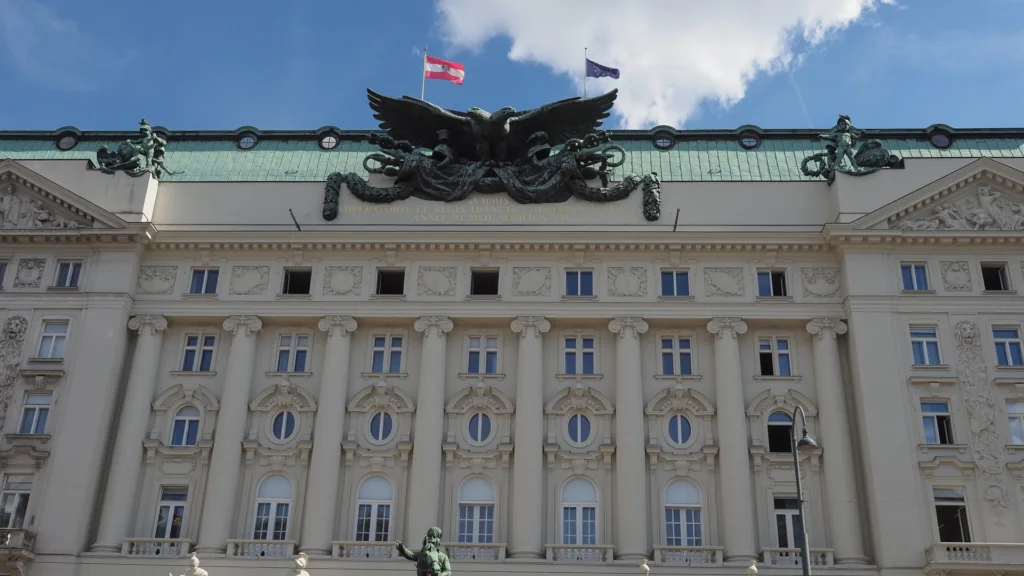
A government building in Vienna flying the Austrian and European flags — illustration. The criteria described here are published by the Interior Ministry, and the Federal Government is the body that confirms the special interest.
The Interior Ministry's criteria for citizenship in the special interest of the Republic carry no euro figure at all, and state that mere flows of money are not sufficient.
Austria’s citizenship law carries a provision under which the Federal Government can confirm that granting citizenship to a particular foreigner lies in the special interest of the Republic. The criteria the Federal Ministry of the Interior publishes for that provision contain no sum of money, no threshold and no fee. What they contain, in the paragraph dealing with economic achievement, is a sentence saying that mere flows of money are not sufficient.
What the Ministry says the provision requires
The provision is §10(6) of the Citizenship Act 1985, which the Ministry describes as a constitutional one. On the Ministry’s account it allows Austrian citizenship to be granted where the Federal Government confirms that the grant lies in the special interest of the Republic on account of extraordinary achievements the applicant has already rendered and is still expected to render. The statute itself was not read for this article, because Austria’s federal legal information system served a bot-verification page and that page was not bypassed. Everything here describing the provision is what the Ministry published about it.
The criteria come from a decision the Council of Ministers took on 25 February 2014, which the Ministry sets out in full. Three of its sentences narrow the provision more than the phrase “special interest” suggests on its own.
Extraordinary achievements, the decision says, are only those currently far above the average in the field concerned. Citizenship under this provision is never granted as an honour; it is granted only for achievements the person has rendered and is still expected to render. And the award of decorations is not by itself enough to establish the special interest.
The criteria are not a checklist. The decision says they need not all be satisfied, and that meeting some of them can be enough where those predominate and carry particular weight when the case is looked at as a whole. The Federal Government is the only body empowered to confirm that the interest exists. Four fields are given as examples — scientific, economic, sporting and artistic — and the page says in terms that the list is not exhaustive and that grants in other fields remain possible.
The economic criteria, and the sentence inside them
The economic limb is the one a business owner would be pointed at, and it reads as a description of what a company has done rather than of what a person has paid.
It asks whether the applicant owns a firm or holds a leading function with decisive influence in one, and adds that board membership alone is not sufficient. It asks about the high economic performance of the company. It asks about the creation and securing of jobs on the Austrian labour market to a relevant extent, and names economically weak regions of Austria in particular. It asks about substantial investments, especially ones already made, or projects carried out by the company in Austria. Then it says that mere flows of money are not sufficient.
Two criteria close the limb. One is how well known the company is abroad. The other is the promotion of Austria’s bilateral and multilateral external relations in the economic sector.
A search of the page’s whole text returns no occurrence of the German words for euro or for capital. The word for investment occurs exactly once, in the clause about investments by the company in Austria.
The founder card is a points test
Austria also operates a Red-White-Red Card for start-up founders. That is a residence permit, and whether or on what timetable it can lead to citizenship is not established by anything read here, so this article does not join the two. It is worth reading beside §10(6) for a different reason: it is the route where Austria does put money figures on the page, so those figures can be weighed against the rest of the test.
Its conditions are published on the migration portal. The applicant establishes a company to develop and launch innovative products, services, processing methods or technologies, submits a consistent business plan, personally exerts controlling influence on the management, proves capital for the company of at least €30,000 with an equity share of at least 50%, and scores at least 50 points.
The points come from four groups. Qualification is worth up to 30, and the highest award there is reserved for a degree or vocational training completed in Austria. Work experience is worth up to 10, at one point per half-year. Language is worth up to 15, and German at C1 or C2 earns that whole 15 on its own. Bonus points are worth up to 30 and divide evenly into three awards of ten. One goes for evidence of additional investment capital of at least €50,000. One goes for admission to a business incubator or funding by a start-up funding agency in Austria. One goes for being aged 35 or under.
The total available is 85 and the pass mark is 50. On those published figures, money buys at most ten points, which is the €50,000 bonus. The €30,000 of company capital is a threshold to cross rather than a scoring item, and carries no points at all. Ten points is a fifth of the pass mark. That arithmetic is this article’s, not the portal’s.
Where the record stops
Four things are open. The statute was not read, for the reason given above. The Federal Government regulation on the procedure for obtaining confirmation is referred to by the Ministry and was not opened, so nothing here describes what it requires. No figure for how many people have been naturalised under the provision appears on the page, and none is given here. And the page describes criteria rather than outcomes, so whether any grant has ever rested on the economic limb is not something this check can answer.
Read this article in Vietnamese
The Legation Times writes its content from published documents; nothing here is legal, tax or investment advice. Spotted an error? Send a correction request; for content rights, send a takedown request.