Dominica proposes to stop taxing residents’ foreign income
 Edward Nguyen
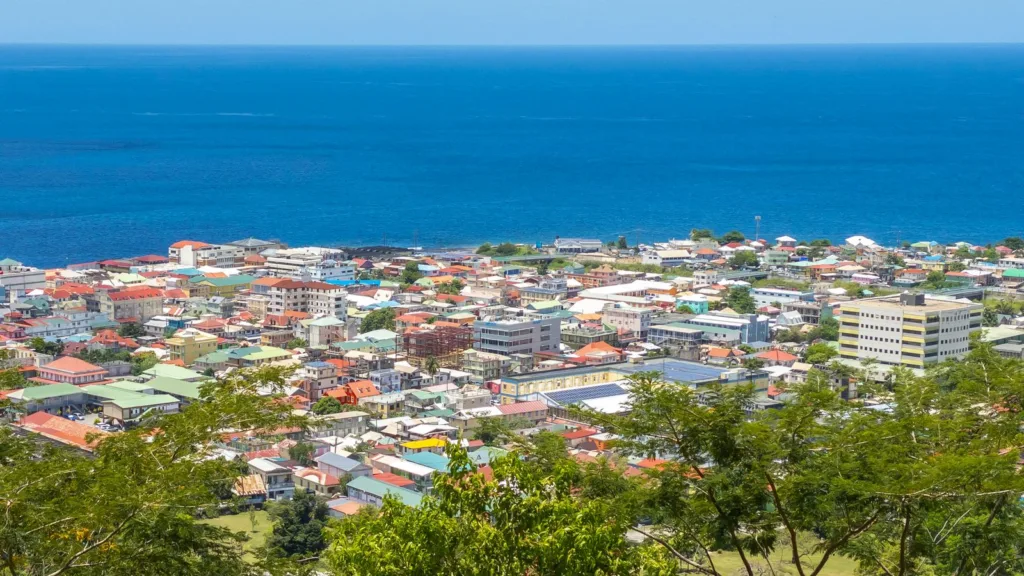
Roseau from the hills. The proposal to stop taxing worldwide income reaches only those who actually become resident in Dominica.
The same budget proposes a flat 10% rate from 1 January 2027. Both were announced as proposals, and on 8 September the government's register of laws showed no income tax amendment later than 2025.
Dominica’s Minister for Finance, Dr Irving McIntyre, told the House of Assembly on 4 August 2026 that the government would remove income tax on income earned outside the country, so that “residents and non-residents will be liable to pay income tax only on income earned in Dominica”. In the same address he proposed replacing the three personal rates of 15%, 25% and 35% with a single rate of 10% from 1 January 2027. Five weeks on, no amending text has been traced.
What the Minister proposed
The Budget Address for fiscal year 2026/2027 puts the rate change in one sentence: “It is therefore my pleasure, Mr. Speaker, to propose that effective January 1, 2027, the Government will replace the income tax rates of 15%, 25% and 35% with a single, flat rate of 10 percent.” The tax-free allowance of $30,000 stays. In the Address’s own illustration, in Eastern Caribbean dollars, someone on $60,000 a year claiming the personal allowance and no other deductions would save $2,500.
The second measure changes what Dominica taxes rather than how much. Removing tax on worldwide income, the Address says, “will encourage Dominican retirees, remote workers and investors to make Dominica their home, knowing that only income earned in Dominica will be subject to tax”. Dominica already taxes non-residents on Dominica-source income alone. The proposal would extend that same source-only treatment to residents, whose foreign income is at present assessable subject to the exception in section 8(2) of the Income Tax Act.
The Address dates the flat rate to 1 January 2027 and leaves the worldwide-income section undated. The Office of the Prime Minister supplied the date the same day, in a release stating that “effective January 1, 2027, residents and non-residents will pay income tax only on income earned in Dominica”. The date is in the release and in the reporting that followed it, not in the Address itself.
What the law says today
The Income Tax Act, Chapter 67:01 still governs. Section 8(1)(a) brings into a resident’s assessable income, “subject to subsection (2)”, all amounts “accrued directly or indirectly from all sources whether in or out of Dominica”; section 8(1)(b) confines a non-resident to amounts “accrued directly or indirectly from all sources in Dominica”. The Inland Revenue Division publishes the bands that go with those charges: nil to $30,000, then 15% to $50,000, 25% to $80,000 and 35% above that.
Read against section 8(1)(b), the Minister’s phrase “residents and non-residents” is wider than the change it describes. What the measure would alter is the treatment of residents, and residence here is a statutory test rather than a matter of choice. Section 2 makes an individual resident on any of three grounds: a permanent place of abode in Dominica together with physical presence there for some period within the basis period, with the Comptroller free to disregard an absence lasting the whole of it where the reason was education, medical treatment, government duties or another the Comptroller thinks reasonable; physical presence of not less than 183 days in the basis period; or a period of presence continuous with a qualifying period in the year immediately before or after. The first ground can therefore establish residence well below 183 days — though owning property does not by itself make Dominica a permanent place of abode.
Subsection (2) is the qualification the charging section carries on its face. A resident who is not ordinarily resident includes foreign income “only to the extent that such income is received in Dominica”, and “ordinarily resident” is defined by the permanent-abode ground alone. Someone resident on the day count but without a permanent home on the island is therefore taxed on foreign income only so far as it reaches Dominica. The current position is already narrower than a pure worldwide charge, and the announcement does not say what would become of that subsection.
Who this reaches
For a citizen who never becomes resident, the foreign-income measure changes nothing. The Citizenship by Investment Unit is unambiguous about the obligation: “You do not have to reside in Dominica before or after citizenship is granted,” and “You are not required to reside in Dominica to keep your citizenship status.” Someone outside the residence test never enters the charge under section 8(1)(a) at all.
The measure could benefit residents and prospective residents whose foreign income would otherwise be assessable — the retirees, remote workers and investors the Address names. For them the exclusion can matter more than the rate cut, because it decides what is counted rather than what is paid on it. Income arising in Dominica stays inside the base either way.
That same unit page also tells applicants there is “no wealth, gift, inheritance, foreign income, or capital gains tax in Dominica”, while adding that a citizen “would be liable to pay personal tax if you resided in Dominica”. The Address treats the removal of tax on worldwide income as something still to be done. Anyone weighing a move should read section 8 and the Address rather than the summary.
No amendment in the register
The government’s register of laws lists 22 income tax instruments, the most recent being the Income Tax (Country-By-Country) Reporting Act, 4 of 2025. Searched on 8 September 2026, it showed no amending Act or Bill of 2026, and the Inland Revenue Division’s guidance page carried nothing on either measure. Both are findings about those sources on that date. The status the Address itself supplies is narrower and firmer: it proposes. KPMG reported both measures as budget proposals on 26 August.
Prime Minister Roosevelt Skerrit went further at a party town hall on 25 August, saying he was not ruling out that “by 2028, we remove income tax altogether” — conditional, on his own words, on the budget measures being implemented and revenues rising. That is a possibility attached to conditions, not a commitment.
What to watch
The amending Bill is the first thing to look for, and the question it must answer is whether section 8(2) and the “ordinarily resident” test survive the change. The rates the Address names are the personal ones; the published company rate is 25%.
Two other threads run alongside. The Address promises a free two-year “Live in Dominica” residence visa for remote workers, retirees and financially independent people earning abroad, conditional on their supporting themselves, holding health coverage and satisfying immigration and security requirements; it names no fee, no start date and no instrument. And it states that under the regional citizenship regulator’s Act, passed by Dominica’s Parliament last October, new economic citizens are to establish a genuine link with the country, spend at least 30 days there within five years of the grant and take part in approved integration programmes. As this desk reported on 27 August, that regime starts only on the deposit of a fifth instrument of ratification, which sets a further 30 days running, on a declaration of provisional application by three states, or on a national commencement Order in the Gazette. No notice of any of the three was located on 8 September. Thirty days spread over five years meets none of the grounds in section 2 on its own. A permanent place of abode, combined with presence in the basis period, meets the first.
Read this article in Vietnamese
The Legation Times writes its content from published documents; nothing here is legal, tax or investment advice. Spotted an error? Send a correction request; for content rights, send a takedown request.