Croatian law grants no citizenship or residence for money alone
 Edward Nguyen
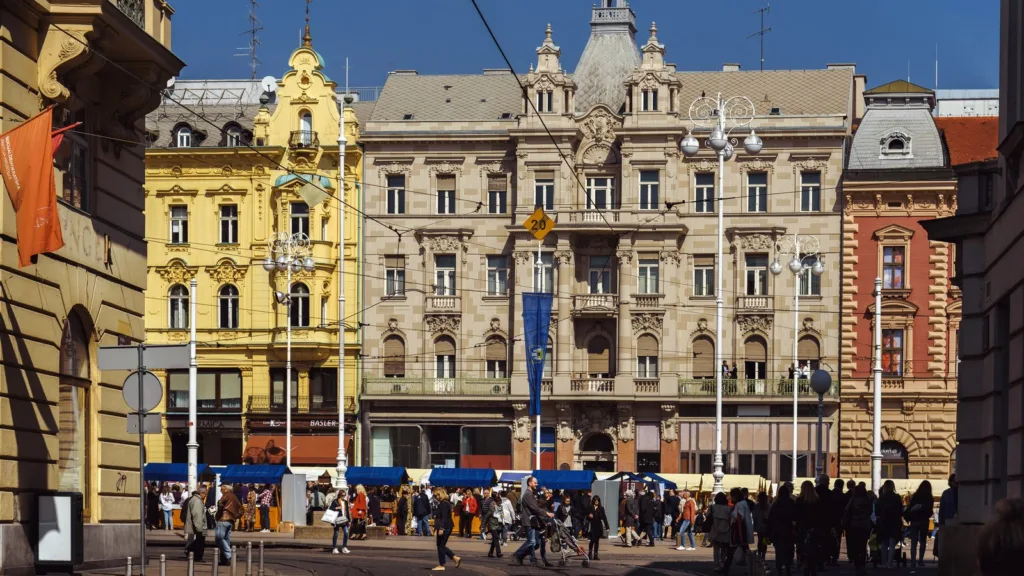
Ban Jelačić Square in central Zagreb. Croatian law has no citizenship or residence route for a set investment. Photo: Magnific.
Neither Croatian law trades citizenship or residence for a sum of money. The kuna figure some advertisements quote is a condition of work permits for company owners and key staff, not of citizenship.
Croatia has no programme that grants citizenship or residence for a fixed investment. Pages advertising Croatian citizenship for EUR 100,000, or a golden visa through property, describe rights that neither the Citizenship Act nor the Foreigners Act grants. The one amount they quote that the law contains, HRK 200,000, now EUR 26,544.56, is a condition of stay and work permits for company owners and key staff, each of which also requires Croatian full-time employees.
What the advertisements say
Three English-language pages checked by TLT make five claims. One says a foreigner can become a citizen with an initial investment of HRK 200,000, about EUR 27,000, and by hiring three Croatian workers. Another, on the same website, says citizenship is guaranteed for an investment of EUR 100,000, that buying property instead of opening a company still guarantees it, and that a residence programme for investors gives permanent residence. The third says citizenship through investment needs eight years’ residence plus at least EUR 100,000. TLT checked each claim against the Croatian statutes published in Narodne novine, the official gazette, and against European Union documents.
Citizenship: eight years, or a discretionary exception
Ordinary naturalisation is governed by Article 8 of the Citizenship Act, as amended in 2011 and 2019. An applicant must be 18; must have been released from a foreign citizenship or show that release will be granted on admission; must have lived in Croatia with registered residence for eight continuous years and hold permanent-residence status; must pass a check of the Croatian language and Latin script, culture and social system, from which people over 60 are exempt; and must respect the legal order, have paid public dues and pose no security obstacle. Where a foreign state does not allow release, or sets conditions that cannot be met, a declaration renouncing that citizenship on acquiring Croatian citizenship is enough. The texts of the Act and of its 2011, 2015, 2019 and 2021 amendments contain no word for investment, investor, real estate or euro. The last amendment, in force since 1 January 2022, changed two deadlines.
For a foreign investor with no family or ethnic tie to Croatia, the only exception is Article 12. A foreigner whose admission “would represent an interest for the Republic of Croatia” may be naturalised without meeting the first four conditions of Article 8, which include the residence period, the release from another citizenship and the language check; the fifth, on the legal order, public dues and security, still applies. Since 1 January 2020, at the request of the Ministry of the Interior, the competent ministry or central state office gives a reasoned opinion from which that interest “undoubtedly” follows. Separately, under a rule in the Act since 1991, the Ministry of the Interior may refuse any application even when every condition is met. Article 12 names no amount and creates no programme. The Ministry of the Interior’s citizenship page lists no investor category.
Article 12 has been invoked for business cases. A contractor’s study annex dated October 2018, published by the European Commission and using data from the Croatian authority, recorded seven positive opinions on economic or commercial interest from the Ministry of Economy in 2012–2016, two in 2012 and five in 2014, alongside 171 naturalisations under Article 12 in the same period. The daily Novi list, citing Ministry of the Interior figures, reported 318 Article 12 naturalisations from January 2012 to March 2022. Neither source gives a price.
The European Commission’s 2019 report on investor citizenship and residence schemes found that Bulgaria, Cyprus and Malta were the only member states operating investor citizenship schemes. It noted that discretionary naturalisation “can be used in individual cases to grant citizenship in exchange for investment”, called such procedures highly individualised and limited, and left them outside its scope. It named Austria, Bulgaria, Slovenia and Slovakia as the states whose legislation explicitly equates national interest with economic or commercial interest; Croatia was not among them. TLT has reported on Austria’s published criteria. In April 2025 the Court of Justice of the EU held that Malta’s scheme breached EU law because granting nationality in exchange for predetermined payments or investments makes its acquisition a mere commercial transaction; TLT covered the judgment in August.
Residence: the purposes the law lists
The Foreigners Act grants temporary stay for a closed list of purposes in Article 57 that includes a catch-all, other purposes: family reunification, secondary education, study, research, humanitarian reasons, life partnership, work, posted work, long-term residents of another European Economic Area state, other purposes and digital nomads. A 2025 amendment added the return of the Croatian diaspora. None of the purposes is investment or property ownership, and none of the four amendments since 2020 created one.
The figure in the advertisements
The HRK 200,000 figure appears three times in Article 113, now as EUR 26,544.56. Two paragraphs set it as the minimum share capital of a company that employs a third-country national as key staff, with at least three Croatian full-time employees for each such foreign worker. The third, closest to the advertisements, governs the self-employment stay and work permit. The applicant must own at least 51% of a company or craft and have invested at least EUR 26,544.56 in founding it, the HRK 200,000 converted at the rate of 7.53450 kuna to the euro when Croatia adopted the euro on 1 January 2023. Article 113(3) still describes the applicant as the sole owner, while Article 110 and a 2025 amendment use the 51% threshold. At least three Croatian citizens must be employed full-time on indefinite contracts at no less than the previous year’s average gross wage published by the statistics office, and the owner’s own monthly gross pay must be at least 1.5 times the average; the owner of a craft must instead show self-employment income of at least 1.5 times the average net wage. Since March 2025 a majority owner must use this permit and cannot instead take an ordinary work permit for the same or another company.
A separate permit in Article 115 covers key staff or majority owners of companies that receive investment incentives or carry out strategic investment projects. It attaches no personal investment amount to residence.
The self-employment permit is a right to stay in order to run a business. The Commission’s 2019 report counted Croatia’s company-based permit, then with a minimum of HRK 100,000, among the investor residence schemes of 20 member states, and placed Croatia outside the group whose schemes require buying or renting property. That report and its staff working document, which dates the Croatian scheme to 2011, are the only official texts TLT found that describe anything in Croatian law as an investor route. The Foreigners Act does not list time on the permit among the stays excluded from the five years needed for long-term residence. It does not make the holder a citizen: the Citizenship Act still requires eight years’ residence, permanent-residence status and the other conditions of Article 8.
Property
Owning property in Croatia gives no right of residence. The only provision on property that TLT found in the Foreigners Act and its amendments was added in March 2025: a retired third-country national over 60 who owns property in Croatia, and his or her spouse or partner, may have a stay “for other purposes” extended. For everyone else that stay lasts up to one year, and a new application is possible only six months after the previous one expires. Time on it does not count towards the five years needed for long-term residence, except for the retiree property owner and his or her spouse or partner. The law sets no minimum property value.
What it means for Vietnamese applicants
A Vietnamese citizen following the ordinary route would need eight years’ registered residence, permanent-residence status, the language and culture check unless over 60, and release from Vietnamese citizenship, proof that it will be granted, or, where Vietnam does not allow release or sets conditions that cannot be met, a declaration renouncing it. Article 12 can waive those conditions only by a discretionary decision that no agent can promise. The route the advertisements price is a work permit that obliges the holder to run a company and employ three Croatians.
What this article has not established
TLT found no statement from the Croatian government denying that a golden visa or citizenship-by-investment programme exists; the finding rests on the statutes. It did not establish how the Ministry of Economy assesses economic interest under Article 12, and found no Article 12 figures after March 2022. Four early amendments to the Citizenship Act, from 1991 to 1994, were not opened; the 2011 and 2015 amendments do not touch Article 12, and the consolidated text attributes its current wording to the 1991 Act and the 2019 amendment. It did not establish how the Foreigners Act’s long-term residence corresponds to the permanent-residence status that Article 8 of the Citizenship Act requires, or whether the implementing rulebook treats property ownership as supporting evidence for a stay for other purposes. The advertising pages checked are in English; TLT found no Vietnamese-language advertisement in three searches.
The Legation Times writes its content from published documents; nothing here is legal, tax or investment advice. Spotted an error? Send a correction request; for content rights, send a takedown request.