Cabo Verde’s citizenship-by-investment law sets no minimum amount
 Edward Nguyen
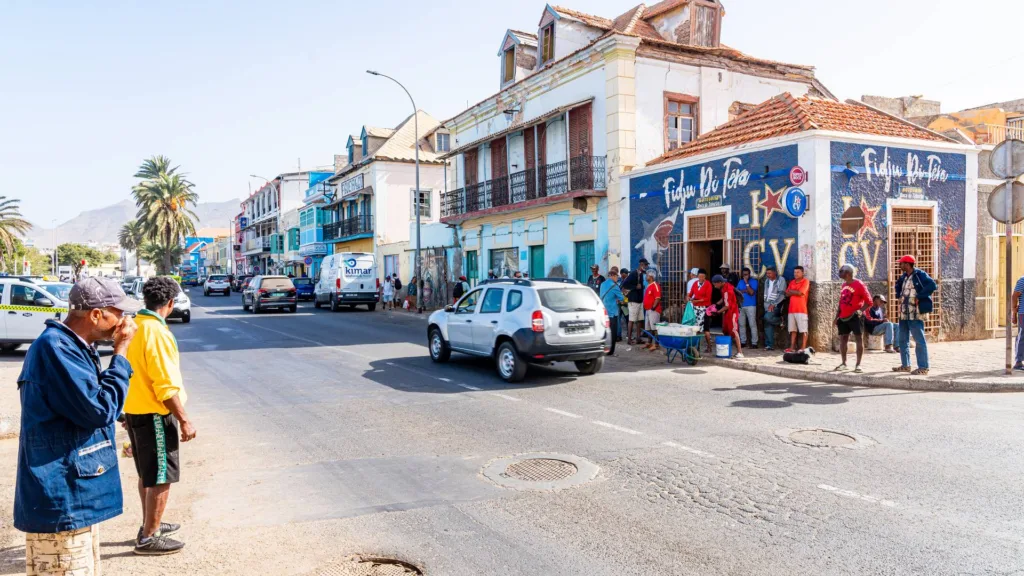
A street in Mindelo, on São Vicente, Cabo Verde — illustration. The 2023 nationality law lists eight forms of investment for citizenship and states no minimum amount.
The deadline for the special regulation meant to fix the amounts passed on 30 June 2024; a 2025 decree lists what remote-work visa applicants must file, including income evidence, but no minimum income.
Cabo Verde wrote citizenship by investment into law three years ago. Law No. 33/X/2023, published in the Official Bulletin on 22 August 2023, lets the government grant nationality to a foreigner who makes an investment of “relevant interest” to the islands and shows an effective connection to the national community. What the law does not contain is a price. Every amount it mentions is left to later legislation, and the special regulation that was meant to supply the amounts and the procedure had a statutory deadline of 30 June 2024.
What the 2023 law provides
Article 14 of Law No. 33/X/2023 says nationality “may be granted” to a foreigner who, personally or through a shareholding in a company, makes investments of relevant interest to Cabo Verde, or offers secure guarantees of making investments that clearly increase employment and contribute significantly to the country’s development. The applicant must also demonstrate an effective connection to the national community. The grant is discretionary: under Article 17 it is made by order of the minister responsible for justice, on application.
The article then lists, “notably”, eight forms that a qualifying investment may take:
- projects that have raised employment and contributed significantly to development, or to exports, workforce skills or new technology, under criteria fixed by law;
- the purchase, for tourism operation, of property classified by law as a tourism development, at a minimum amount and number of jobs fixed by law;
- forming or joining a regional development company, with an effective relevant investment, under the law;
- the transfer to Cabo Verde of a minimum amount of convertible foreign currency into investment or capital funds, at a level fixed by law;
- specific projects under agreements with the government or with municipalities, at an amount no lower than a minimum the Act leaves “to be established”;
- commercial establishments or significant shareholdings in Cabo Verdean companies working in areas the government considers strategic, at an amount defined by law;
- other investments that the Council of Ministers qualifies as relevant by resolution;
- consistent and lasting action over at least 10 years promoting economic activity for Cabo Verde, where it has contributed in a particularly significant way to attracting relevant foreign investment and to the country’s development.
Minimum amounts, the law adds, may differ by economic sector and by where a project is located. None is stated in the Act. The preamble describes the change as recasting the old concept of “economic nationality” as nationality by investment, with a regime of its own separate from naturalisation.
The regulation that was due by 30 June 2024
Seven months after publication, parliament amended the law. Law No. 37/X/2024, published on 22 March 2024 and in force the next day, left Article 14 untouched and amended eight other articles, among them the two closing ones. The amended Article 38 required the government to regulate the law by 30 April 2024, “save the acquisition of nationality by investment, which will be regulated by 30 June of the same year”. The amended Article 40 brought the law into force on the start date of the general regulation, “with the exception of the acquisition of nationality by investment”.
The preamble to the amendment gives the reason in two sentences. The deadline was extended because, for investment, the various branches of government would need more time to define the qualifying criteria and amounts. And, aware that in practice the nationality law would have no applicability without the approval of the regulation, parliament amended Article 40.
The general regulation followed. Decree-Law No. 29/2024, approved by the Council of Ministers on 23 April 2024 and published on 13 June 2024, regulates the procedures under the law with the exception of acquisition by investment and effective connection to the community. Its Article 2 excludes those processes from its scope because they are to be regulated by a special instrument, and its Article 61 says the investment process is governed by a special regulation of its own.
What the general regulation already settles
Although the decree leaves the investment process to a special regulation, the section it devotes to the investment route does set one element: how an effective connection to the community is proven. Under Article 60 a foreigner shows either reasonable knowledge of Portuguese or Cabo Verdean, or a record of entries and stays. The language test is presumed to be met, at the time of the nationality declaration, by someone born in and a national of a country whose official language is Portuguese, by someone married to, or in a recognised de facto union with, a Cabo Verdean of origin for at least two years, or by someone who attended school in Cabo Verde. The travel test is presumed to be met by at least two entries in each of the three years before the declaration, with a stay of at least 15 days each time, or by at least two years of legal residence with at least six months in the country each year.
What the Official Bulletin index shows
The Legation Times checked the online index of the Official Bulletin kept by the national press, Imprensa Nacional de Cabo Verde, in two ways on 24 September 2026. A search for “nacionalidade” among Series I acts from 2023 to September 2026 returned 57 acts, including the 2023 law, the 2024 amendment and the general regulation; the summary of each was read. For 2023 and 2024 that search appears to cover act summaries only. A second pass, without a search term, went through all 933 Series I acts the index lists for 2025 and to 24 September 2026, reading the summary of each; it did not cover 2023 or 2024. Neither pass found a special regulation for the acquisition of nationality by investment.
For an investor, the position rests on the texts. The Act states no investment amount, the general regulation reserves the investment procedure to a special regulation, and neither check of the index found it. Figures of around 200,000 US dollars or euros that circulate on adviser and marketing websites do not appear in the Act, the amendment or the general regulation.
The remote-work residence visa
A separate route, for people who move their work rather than their capital, rests on the Aliens Law. Law No. 27/X/2023, published on 8 May 2023 and in force the next day, inserted Article 53-A into the Aliens Law: a residence visa for employees and independent professionals who work remotely for people or companies domiciled outside Cabo Verde, provided the employment or service relationship is demonstrated.
Decree-Law No. 13/2025, published on 15 May 2025, sets out in a new Article 29-A what an application must include:
- the biographical page of the passport;
- a criminal record certificate from the country of origin;
- for an employee, the employment contract or an employer’s declaration;
- for an independent professional, a company or service contract, or evidence of services to one or more clients;
- proof of average monthly income from that work over the last three months;
- a document attesting tax residence.
The decree ties the visa to the government’s “Nómadas Digitais” initiative. Applications for residence visas may be filed through an online platform, which the decree does not name, or at the counters of the Directorate of Foreigners and Borders.
Neither Article 53-A nor Article 29-A states a minimum income. Earlier figures exist: the Ministry of Tourism and Transport launched the Remote Working programme in December 2020, and the Portuguese news agency Lusa reported in June 2021 that it required an average bank balance of at least EUR 1,500 over the previous six months for an individual and EUR 2,700 for a family, for stays of six months. Those figures predate the 2023 statute and do not appear in either article.
What to watch
Two points need checking before either route is relied on. For citizenship, whether a special regulation in the Official Bulletin sets the investment procedure and the minimum amounts for the forms listed in Article 14. For the remote-work visa, whether the Directorate of Foreigners and Borders publishes guidance on the income it treats as sufficient. On the texts read, the 2023 Act lists the forms an investment may take and the general regulation sets how a connection to the community is proven; neither states a minimum investment amount.
Related programmes
- Cabo VerdeCitizenship by investment Not yet open
- Cabo VerdeDigital nomad visa Not yet open
The Legation Times writes its content from published documents; nothing here is legal, tax or investment advice. Spotted an error? Send a correction request; for content rights, send a takedown request.