Two Cyprus routes to one permit name, five times apart on income
 Edward Nguyen
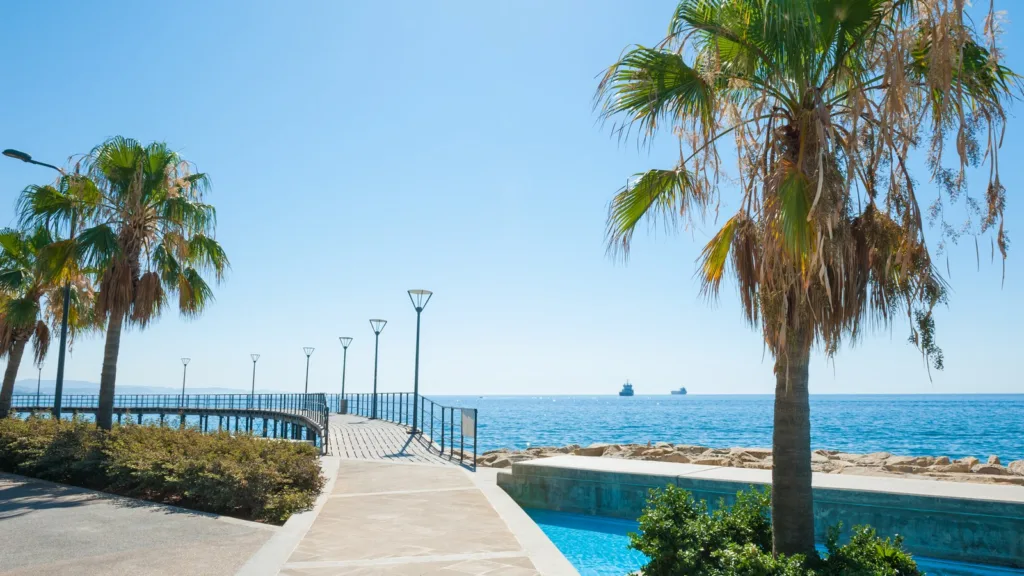
The seafront at Limassol. Cyprus sets two income floors behind the same permit name, and the two figures sit in two different kinds of document.
Category F asks a secured annual income of at least €9,568, a figure the department still prints beside the Cyprus pound; the route under the next regulation asks at least €50,000 and €300,000 of capital.
Cyprus issues a document called an immigration permit, and two routes lead to that name. One is a category in a list of six, drawn for a person with a secured income from abroad. The other is a policy a minister writes, drawn for a person who invests. Each route sets its own income floor, and the two floors differ by a factor of five.
What the list says, and in which currency
Regulation 5 of the Aliens and Immigration Regulations sets six categories of immigration permit, lettered A to F. Categories A, B and C cover self-employment in agriculture and related activity, in mining, and in a trade or profession, and each names a sum of capital that the Immigration Control Committee may set lower. Category D covers self-employment in an occupation or science for which the Republic needs more practitioners, and Category E an offer of permanent employment that will not create undue local competition. Neither names a figure.
Category F covers persons who possess and have fully and freely at their disposal from abroad a secured annual income of an appropriate amount to allow them a decent living in Cyprus, without having to engage in any business, trade or profession in the Republic. The required income is at least €9,568 for the applicant and at least €4,613 for every dependent person. The text gives pensions, dividends from shares, fixed deposits interest and rents as examples, and does not close the list.
The Immigration Control Committee recommends; the Deputy Minister of Migration and International Protection grants. A permit covers the holder’s spouse and children under 18. For the holder and adult dependants the residence right runs without limit, though the card expires ten years from issue and must be replaced; a minor dependant’s card runs only to the age of 18. The fee is €500 for everyone on one application, with €70 more where an Aliens Registration Certificate is needed.
Every figure in the list is published twice. The department’s page, posted on 29 December 2025, gives Category A as approximately €430,000 (CY£250,000), Category B as approximately €350,000 (CY£200,000), Category C as approximately €260,000 (CY£150,000), and Category F as €9,568 (CY£5,600) and €4,613 (CY£2,700). The Cyprus pound was replaced by the euro on 1 January 2008.
The second route sits one regulation away
Regulation 6(2) carries the other route, and it is not a list of categories. Under it the Minister of Interior, having notified the Council of Ministers, decides to issue an immigration permit in cases of investment meeting a stated policy. That policy is a document the department publishes and revises; the current text is marked fourth revision, May 2023.
It asks for at least €300,000 in one of four forms:
- a first-sale house or apartment from a development company;
- other real estate, including on resale;
- the share capital of a Cyprus company with a physical presence and at least five employees;
- units in a Cyprus collective investment undertaking.
On top of the capital it asks for a personal secured annual income of at least €50,000, rising by €15,000 for a spouse and €10,000 for each dependent minor child.
Where that income may come from depends on which investment is chosen. An applicant who buys the house or apartment must show income derived from abroad, evidenced by a tax return from the country of tax residence, and may count a spouse’s income towards the total. An applicant who takes one of the other three options may draw all or part of that income from activities within the Republic.
Neither route is built around work in Cyprus
The two routes describe the applicant’s relationship to local employment in different registers. Category F is drawn for a person who does not have to engage in any business, trade or profession in the Republic — wording that describes a financial position rather than imposing a ban. The investor policy is explicit: the applicant and spouse must confirm that they do not intend to undertake any form of employment in the Republic, and the exception named is a directorship in the company they invested in. Neither formulation reaches employment outside Cyprus.
Each route also carries a condition the other’s page does not state. The investor permit is tied to the asset: disposing of the investment without immediately replacing it with one of equal or greater value cancels the permit under Regulation 6. The immigration-permit page sets out a different exposure — a permit ceases to be valid if the holder, while residing outside Cyprus, fails to take up residence within a year of approval, or if the holder acquires permanent residence abroad or is absent from Cyprus for two years.
What the figures turn out to be
Council Regulation (EC) No 1135/2007 of 10 July 2007 fixed the conversion rate at 0.585274 Cyprus pounds to the euro, with effect from 1 January 2008. Applying it to the published figures separates them into two groups.
The Category F amounts match the conversion to the euro. CY£5,600 at that rate is €9,568.17, and the page gives €9,568. CY£2,700 is €4,613.22, and the page gives €4,613. Both fractions fall below half a euro, so the arithmetic cannot tell rounding from truncation, and it says nothing about how the figures were arrived at.
The capital thresholds do not match. CY£250,000 is €427,150 against €430,000 published; CY£200,000 is €341,720 against €350,000; CY£150,000 is €256,290 against €260,000 — the published figures sit 0.67, 2.42 and 1.45 per cent above the converted ones, each landing on a round number. The page marks the difference in its own words: A, B and C are introduced as approximately. Category F is not.
Set against each other, the two income floors stand at €50,000 and €9,568, a ratio of 5.23.
What this article does not establish
Whether the Category F amounts have been amended since 2008 is not established here. The consolidated Regulations were not read: one Cyprus legislative portal serves a bot-verification gate, which was not passed, and another returned an error on its subsidiary-legislation index. What can be said is dated and narrower — that the competent department, on a page posted 29 December 2025, states the threshold in euro beside a Cyprus pound figure.
For the same reason, who may amend each figure, and by what procedure, is not established. The evidence read covers who decides applications, not who rewrites requirements. The label fourth revision records that the investor policy has been reissued, not that its income figure changed four times.
Why the Category F amounts track the conversion while three other categories do not is not explained on any page read. Nothing read gives the number of permits granted on either route.
Regulation 5 sets a qualitative test beside the quantitative one: the income must be of an appropriate amount to allow a decent living. No source read states which governs where the two diverge, or whether the €9,568 floor is treated as sufficient in practice.
The absence rule appears on the page for the Regulation 5 categories. Whether it reaches a permit issued under Regulation 6(2) was not established, nor was what becomes of a dependent child’s own residence right at 18, nor whether either income test is measured gross or net, or over what period. How income is evidenced is stated only for the investor route’s residential option, where a tax return is required; for Category F no source read says.
What follows
Both routes are written for people who are not coming to Cyprus to take a job. That is nearly all they share: three of the four investor options accept money earned in the Republic, and Category F does not. It does not explain the gap between €9,568 and €50,000 — the investor route also demands €300,000 of capital and continued exposure.
What the record shows is where each number is published. One appears in a list of categories, in euro beside the currency the country used until 2008. The other appears in a policy the Minister of Interior issues and has reissued, last in May 2023. Which hand can move which number, the pages read here do not say.
Read this article in Vietnamese
The Legation Times writes its content from published documents; nothing here is legal, tax or investment advice. Spotted an error? Send a correction request; for content rights, send a takedown request.