Latvia drops its property route; Greece, Cyprus and Malta keep theirs
 Michael Mai
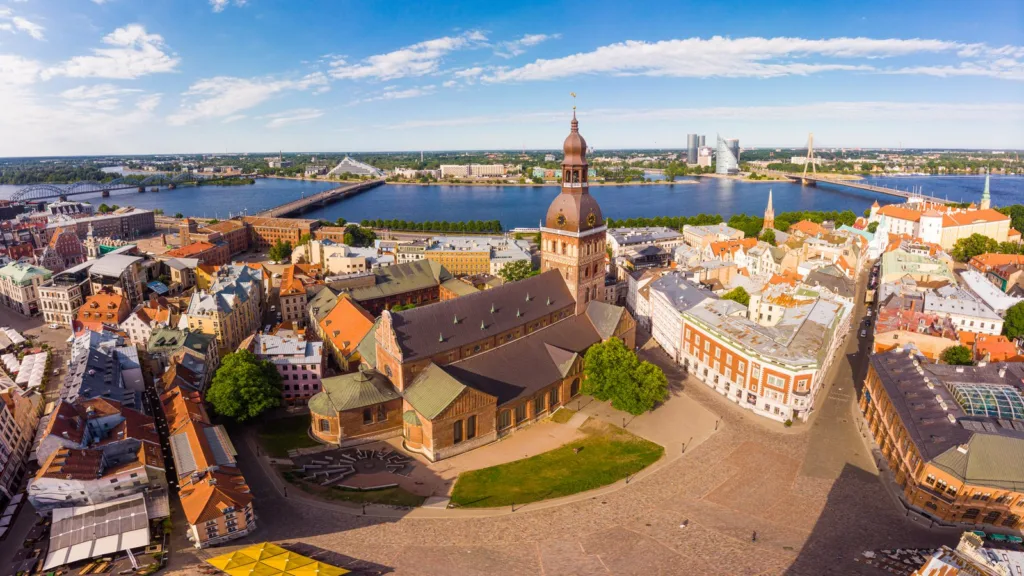
Riga's Dome Cathedral and Old Town on the Daugava — illustration. Latvia's new Immigration Law, in force since 15 September 2026, no longer lists a property route for new applications.
Latvia's new law omits property purchases as a ground for new investor permits; Greece, Cyprus and Malta retain home-based options, subject to investment and eligibility requirements.
Since 2023, European governments have closed investor residence routes or taken property out of them. Latvia is the latest: its new Immigration Law, in force since 15 September 2026, lists neither a real-estate route nor a bank subordinated-debt route among the grounds for new permits. Of nine national investor schemes in the EU whose official texts were read for this article, three still offer a direct home purchase: Greece, Cyprus and Malta.
Where property was taken out
Ireland closed its Immigrant Investor Programme at close of business on 15 February 2023, according to the Department of Justice; applications already made continue to be considered.
Portugal removed the capital-transfer route and both real-estate routes from its investor permit with effect from 7 October 2023, and the immigration agency, AIMA, now states that the investment may not be directed at real estate, directly or indirectly.
The Netherlands abolished its residence ground for wealthy foreign investors from 17 April 2024. Spain’s Organic Law 1/2025 emptied every investor article of its 2013 law, not only the property one, with effect from 3 April 2025. Applications filed before that date are decided under the old rules.
Latvia’s new Immigration Law was adopted on 20 August 2026 and replaced the 2002 law. The old law allowed a permit for property worth at least 250,000 euros or for 280,000 euros in subordinated liabilities of a Latvian bank. Neither is listed among the grounds for new applications. Transitional provisions let existing holders apply for repeat permits of up to five years, provided they apply while their permit is valid, the investment still meets the old conditions and they make the transitional payments. The immigration office’s English pages, last updated in April 2022, still describe the old requirements.
Hungary’s immigration authority lists two investment options for its guest investor permit, neither of them a direct property purchase. Luxembourg’s parliamentary committee recommended on 16 September 2026 that its investor permit be abolished; the Chamber has not voted.
Investor citizenship has gone the same way. Cyprus ended its programme on 1 November 2020 and Bulgaria repealed its provisions in April 2022. On 29 April 2025 the EU Court of Justice held that Malta could not grant citizenship in exchange for predetermined payments or investments, according to the Court’s press release, and Malta has since removed the route.
Where a home still counts
Greece raised its thresholds under Law 5100/2024, in force from 5 April 2024. A ministry circular of 21 April 2026 confirms 800,000 euros in Attica, the Thessaloniki regional unit, Mykonos, Santorini and islands of more than 3,100 inhabitants, and 400,000 euros elsewhere, for a single property; at these tiers a built or permitted property needs at least 120 square metres of main space. The 250,000-euro level now applies only to converting a building to residential use or restoring a listed building. Short-term letting through platforms is banned.
Cyprus grants permanent residence for an investment of at least 300,000 euros, plus VAT where applicable, according to the Deputy Ministry of Migration. The investment may be a new home bought from a developer, other real estate, company capital or Cypriot fund units. The applicant must also show annual income of 50,000 euros, plus 15,000 for a spouse and 10,000 for each minor child; for the new-home option it must come from abroad, while for the others it may come partly or wholly from Cyprus.
Malta’s permanent residence programme accepts a property bought for at least 375,000 euros or rented for at least 14,000 euros a year, held for five years, after which a residential property must still be kept, according to Residency Malta. The applicant also pays a government contribution of 37,000 euros, an administrative fee of 60,000 euros and a 2,000-euro donation, and must hold capital of 500,000 euros including 150,000 in financial assets, or 650,000 euros including 75,000.
Options without a direct property purchase
Portugal’s standard options include creating 10 jobs, 250,000 euros for arts or cultural heritage, 500,000 euros for research (400,000 in low-density areas), 500,000 euros in non-real-estate investment funds, and 500,000 euros in company capital creating five permanent jobs for at least three years. Italy’s investor visa asks for 250,000 euros in an innovative start-up, 500,000 euros in an Italian company, 1 million euros as a donation or 2 million euros in government bonds.
Hungary’s two options are 250,000 euros in units of a registered real-estate fund, held for five years, or a donation of 1 million euros to a higher-education institution maintained by a public-interest trust foundation, according to the immigration authority. Latvia’s new law keeps company capital of 50,000 or 100,000 euros, depending on the company’s size and its annual tax payments, now for permits of up to two years instead of five. It adds at least 150,000 euros for at least five years with a state-established alternative investment fund manager. Both Latvian routes carry a further payment of 10,000 euros to the state.
What changed for a Vietnamese applicant
Portugal’s Organic Law 1/2026, in force since 19 May 2026, requires 10 years of legal residence before naturalisation for nationals of countries outside the EU whose official language is not Portuguese, and seven years for the others. Vietnam’s Constitution names Vietnamese as the national language, so the 10-year period applies to Vietnamese nationals. Nationality procedures already pending continue under the previous rules.
Official guidance lags behind the law in two of these countries: Greece’s English golden visa page and Latvia’s English permit pages still describe superseded requirements.
Limits of this reading
The nine schemes are those whose official texts could be read on 26 September 2026; the list is not exhaustive. Estonia is included through its business-permit framework. The Portuguese permit’s validity period, the instrument that removed Hungary’s direct property option, and Latvia’s minimum stay could not be established from official sources.
The Legation Times writes its content from published documents; nothing here is legal, tax or investment advice. Spotted an error? Send a correction request; for content rights, send a takedown request.