Swiss residence: no investment floor, federal base from CHF 435,000
 Michael Mai
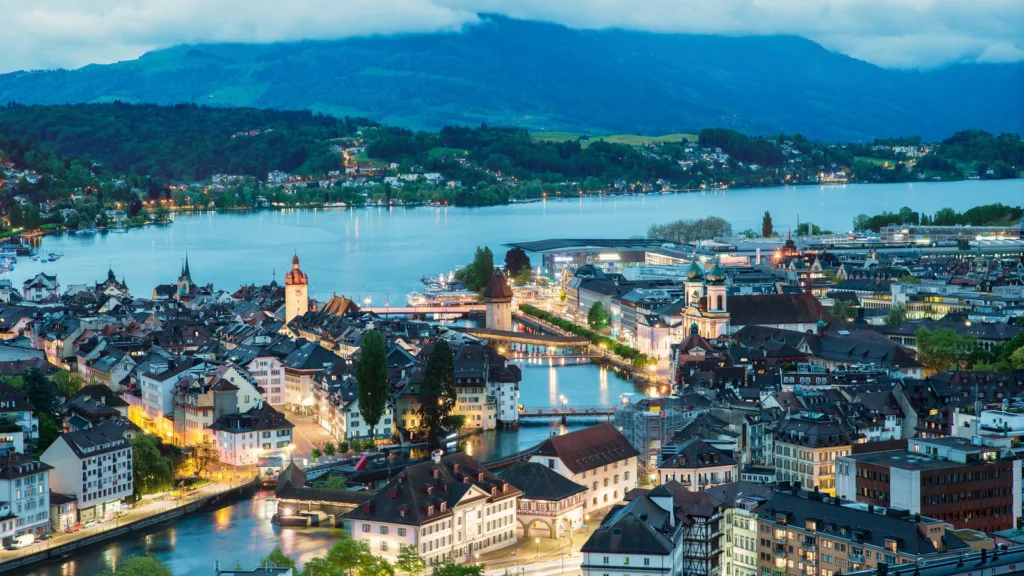
Lucerne old town on Lake Lucerne, Switzerland — illustration. Non-working foreigners may be admitted to Switzerland as retirees or for a canton's fiscal interest; the rules set no investment threshold.
Swiss residence rules set no investment threshold; for eligible foreign residents who do not work, the 2026 federal lump-sum tax base starts at CHF 435,000, while cantons set their own floors.
Switzerland’s immigration ordinance states that buying property or founding a company does not, on its own, create any claim to a permit. This article examines two grounds on which a national of a country outside the EU and EFTA may live there without working: retirement, which requires sufficient financial means, and a canton’s significant fiscal interest in the applicant.
Two grounds, both at the authorities’ discretion
The Foreign Nationals and Integration Act allows retirees to be admitted if they have reached a minimum age, have special personal ties to Switzerland and have the financial means they need. The implementing ordinance sets the age at 55 and forbids gainful activity, in Switzerland or abroad, other than managing one’s own assets. The financial test is not a figure: the applicant’s means must exceed the level at which a Swiss citizen would qualify for supplementary old-age benefits.
The ordinance gives examples of special ties, including substantial earlier stays and close relationships with relatives in Switzerland. The State Secretariat for Migration (SEM) adds in its directives that ties must also exist independently of those relatives, and that owning property or having business links with Switzerland does not, by itself, meet the condition.
The second ground is Article 32 of the ordinance, which allows a permit to protect important public interests, among them significant cantonal fiscal interests. The SEM directives say that a person admitted on that ground may work only abroad, apart from managing their own assets, and must move the centre of their life to Switzerland and spend most of their time there. Zurich and Vaud go further and prohibit gainful activity in Switzerland or abroad, except managing one’s own assets; Vaud requires a formal undertaking.
Both provisions say a permit may be granted. The SEM describes a wide margin of discretion, citing a Federal Administrative Court ruling of 11 June 2024, and states that the fiscal interest must be weighed against Switzerland’s interest in protecting its reputation, case by case. For nationals of countries outside the EU and EFTA, both a retiree permit and a public-interest permit must be submitted to the SEM for approval.
What the lump-sum tax asks for
Taxation according to expenditure, often called lump-sum taxation, is a separate tax entitlement. Under Article 14 of the Federal Act on Direct Federal Tax it is open to people who are not Swiss citizens, who become fully taxable in Switzerland for the first time or after at least 10 years away, and who do not work in Switzerland. Both spouses must meet the conditions.
The tax is assessed on the annual living costs of the taxpayer and dependants, in Switzerland and abroad, but the base must meet the highest applicable statutory amount:
- a fixed minimum, CHF 435,000 for the federal tax from 1 January 2026;
- for taxpayers with their own household, seven times the annual rent or rental value;
- for other taxpayers, three times the annual cost of board and lodging;
- specified gross income from Swiss sources, plus income for which relief from foreign tax is claimed under a Swiss tax treaty.
Treaty conditions can require additional foreign income to enter the assessment. The fixed minimum is indexed to inflation: an ordinance of the Federal Department of Finance dated 11 September 2026 raises it to CHF 437,000 from 1 January 2027. Ordinary tax rates are applied to the resulting base.
Cantons decide whether to offer the regime for cantonal and communal taxes and set their own minimum. Valais uses CHF 250,000. Zug uses a taxable income of at least CHF 500,000. Geneva’s figure for 2026 is CHF 426,357, or CHF 468,993 including a 10% surcharge that replaces wealth tax. The Federal Department of Finance lists five cantons that abolished the regime at cantonal level: Zurich, from January 2010, then Schaffhausen, Appenzell Ausserrhoden, Basel-Landschaft and Basel-Stadt. A September 2025 publication of the Federal Tax Administration records an exception in Basel-Landschaft for the year of arrival, ending with that tax period. A proposal to abolish the regime nationwide was rejected in a vote on 30 November 2014, with 40.8% in favour.
What cantons ask in practice
Zurich’s migration office, in a directive of 19 November 2021, treats the fiscal interest as sufficient when an applicant would pay approximately CHF 1 million in tax a year. The cantonal government of Uri wrote on 12 April 2022 that total federal, cantonal and communal tax must reach at least CHF 200,000 a year, and that such admissions concern wealthy people who apply for lump-sum taxation when they move. Vaud asks for a copy of the lump-sum tax agreement concluded with its tax authority.
At the end of 2018, 4,557 people were taxed on expenditure and paid CHF 821 million in total, according to the Federal Department of Finance, whose page directs readers to the cantons for current figures.
From permit to settlement and citizenship
A settlement (C) permit normally requires 10 years on short-stay or residence permits, the last five of them continuously on a residence permit, with integration and no grounds for revocation. The Act allows it after five continuous years on a residence permit for applicants who are integrated and speak the local national language well; this is discretionary. The SEM directives state that tax considerations or property purchases are not, by themselves, a reason to grant it early.
Ordinary naturalisation generally requires a settlement permit and 10 qualifying years of residence, including three in the five years before the application; residence and settlement permits count, short-stay permits do not. Cantons require two to five years of that residence locally, and integration conditions apply. Acquiring Swiss citizenship ends eligibility for lump-sum taxation.
Limits of this reading
No text read for this article expresses the retiree financial threshold in francs. The Federal Department of Finance page gives national figures for 2018 only, and the 2026 minimum for Ticino could not be read from an official page. The texts consulted do not say whether the SEM must approve each renewal.
The Legation Times writes its content from published documents; nothing here is legal, tax or investment advice. Spotted an error? Send a correction request; for content rights, send a takedown request.