New Zealand to open build-to-rent to investor visa’s Growth category
 Michael Mai
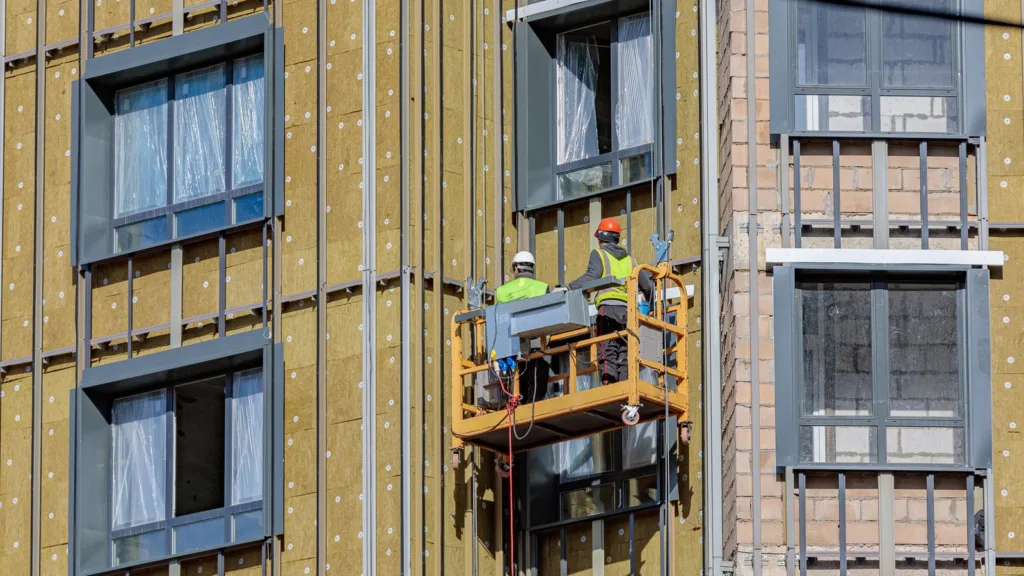
Workers on a suspended cradle at a building nearing completion. From December 2026 build-to-rent counts towards Growth category capital, though the immigration guidance does not yet mention it — illustration.
Ministers say build-to-rent will count towards a Growth investment from December 2026, but the immigration instructions did not mention it as at 13 September; the NZD $5m threshold holds, approved funds only.
New Zealand will let investors on the Growth category of its Active Investor Plus visa put money into build-to-rent housing through approved managed funds, three ministers announced on 8 September 2026. The option is to open in December. The NZD $5 million minimum does not move, investors may not buy into a development directly, and neither they nor their families may live in a building their money helped finance.
What the ministers announced
The release came jointly from Erica Stanford, the Immigration Minister, Chris Bishop, the Housing Minister, and Simon Watts, the Minister of Building and Construction.
Its operative sentences are short. “In December 2026, Growth category applicants will be able to include Build to Rent as part of their overall investment in New Zealand.” The Growth minimum “remains $5 million, and applicants will still need to meet all relevant Active Investor Plus requirements”. Build-to-rent money “will be available through approved managed funds only, and direct investment in Build to Rent developments will not be available”. The approving body is named in the notes: Invest New Zealand.
One restriction appears twice, once in the body of the release and once again in the notes to editors: “Applicants and their family members will not be able to live in a Build to Rent development funded through their investment.”
The wider property route stays where it already sits. Investments in residential and commercial property developments, the release says, “can still take place under the Balanced category”.
What the instructions currently say
They do not say this. As at 13 September 2026 the change exists as an announcement and not as an immigration instruction, and that distinction is the practical one for anyone with an application in train.
Instruction BN7.1 of the Operational Manual sets acceptable investment by category. For Growth it lists managed funds, direct investments and philanthropy to a maximum of 20 per cent. For Balanced it lists listed equities, philanthropy, property development, bonds, managed funds and direct investments. The longer text at BN7.10 sets out the same division at length. Both pages carry an effective date of 1 June 2026, and neither mentions build-to-rent. The applicant-facing page lists the same three Growth options and does not mention it either. The release closes by saying that more information on the detailed requirements is available on the Immigration New Zealand website; on those three pages, read on 13 September, it is not there yet.
Immigration New Zealand describes how an instruction change becomes public: “We publish the circulars when the changes have been certified by Minister of Immigration and incorporate them into the Operational Manual as soon as possible.” The most recent circular on the register is 2026-24, dated 10 September 2026 — two days after the ministers spoke. It introduces the Short-term Graduate work visa and amends post-study work instructions, and does not touch Active Investor Plus.
That circular also shows why publication and commencement are worth keeping apart. It is dated 10 September and takes effect on and after 16 November. A build-to-rent circular could appear well before December and still commence in it.
Who this reaches
The Growth category is where the programme’s volume sits. Figures reported by the financial news site interest.co.nz on 9 September, and attributed there to Immigration New Zealand as at 4 September 2026, record 904 applications since the April 2025 reset, of which 467 were approved — 392 under Growth and 75 under Balanced — with 253 approved in principle, 141 in progress and 43 withdrawn or declined. Around NZD $4.935 billion has been committed or added to the pipeline, being $2.72 billion committed and $2.215 billion in the pipeline.
The ministers’ own summary rounds this to more than 900 applications and around $5 billion, and says more than 80 per cent of applications have come through Growth. That share and the 392-of-467 split measure different things — the first counts applications, the second approvals — and neither source gives the Growth share of the dated cohort of 904.
Capital, period and obligations
The announcement alters nothing else it names. The investment period for Growth remains 36 months from the point all acceptable investments are completed, or from approval in principle where the money went in first. The resident visa still carries conditions under section 49(1) of the Immigration Act 2009: hold the investment for the period, spend at least 21 days in New Zealand as a resident during it, keep contact details current, and file evidence at 24 months and again at the end.
The residence bar announced for build-to-rent is not a new idea in this programme. The Balanced category’s property-development limb already provides that “neither the principal applicant, nor the family or relatives of any person included in the application may reside in the development”, and the same limb excludes house-and-land packages, off-the-plan purchases and the renovation or extension of existing dwellings. The announced wording is close to that without being identical, and the operative Growth text does not yet exist to compare.
Liquidity is the risk the department flags itself. Its applicant page warns that Growth investments “are typically illiquid (not easily converted to cash) and can require a long-term commitment” — and build-to-rent money, by the terms of the announcement, can only travel through that managed-funds route.
What the announcement leaves open
Four questions matter to anyone modelling a file, and the release answers none of them.
- What makes a fund an approved build-to-rent fund. Invest New Zealand approves them. No criteria specific to build-to-rent were located at the time of writing.
- How much of the NZD $5 million may go there. The release says build-to-rent may form part of an applicant’s “overall investment” and gives no proportion or sub-cap.
- How the route will be written into the instructions. The release names approved managed funds; the amended text will show how that route is expressed and what conditions travel with it.
- Whether it reaches applications already in train. An applicant has 6 months from the date of the approval-in-principle letter to transfer and invest the nominated funds, and may be granted one extension of up to 6 months if the request is made inside that first period and supported by evidence of reasonable attempts. Someone approved in principle in August 2026 is therefore still inside the first window in December, and nothing published says whether the new option is open to them.
What to watch
The document to wait for is the amendment circular carrying the certified wording, with its effective date and whatever it says about applications already in train. Until it exists, the Growth list that an application is assessed against has no build-to-rent limb in it.
The release gives December and no day within it, and says nothing about when the underlying detail — the amended instruction, and Invest New Zealand’s basis for approving a fund — will be published, or how much notice applicants will have. That matters more here than it would in a category with a smaller ticket. An applicant is committing NZD $5 million against a 36-month retention obligation, and the terms on which a fund qualifies are not yet on the record. The announcement says what the Government intends; the instruction will say what an application can be assessed against.
Read this article in Vietnamese
The Legation Times writes its content from published documents; nothing here is legal, tax or investment advice. Spotted an error? Send a correction request; for content rights, send a takedown request.