Kuwait’s investor residence runs up to 15 years, tied to the company
 David Le
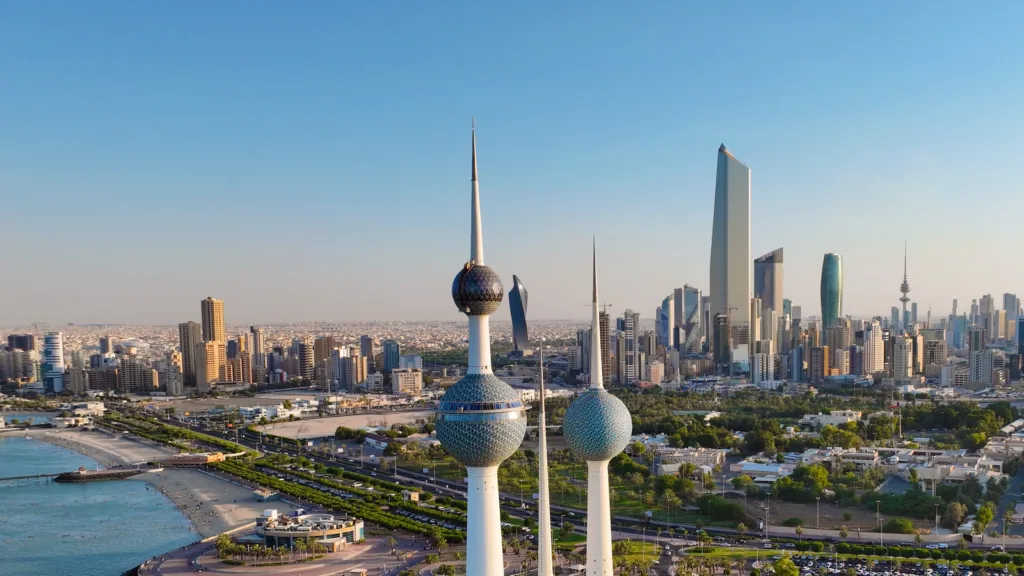
Kuwait City from the bay, with the Kuwait Towers. Investor residence there runs up to 15 years and stays tied to the company named on it.
Two of the four Gulf jurisdictions compared here grant permanent residence from the outset, which makes Kuwait's ceiling of 15 years less generous than it reads, and none of the four promises nationality.
Kuwait’s official gazette, Kuwait Al-Youm, carried Cabinet Resolution No. 651 of 2026 in its issue of Sunday 14 June 2026. It allows the Ministry of Interior to grant an investor residence permit of up to 15 years, the longest fixed term among the four Gulf jurisdictions compared here. What Kuwait asks in return is a company kept in compliance for as long as the permit runs, and a permit that can be cancelled before its term if that stops being true.
What the Kuwaiti resolution requires
The permit is issued by the General Directorate of Residency Affairs at the Ministry of Interior, on a letter from the Kuwait Direct Investment Promotion Authority. The authority’s announcement of 14 June sets two financial thresholds: a licensed entity must maintain an investment value of no less than KWD 5 million, and capital of no less than KWD 1 million for approved investment activities. It must also keep active operations inside Kuwait and meet the minimum quota for employing Kuwaiti nationals. The resolution was issued under Article 13 of Law No. 114 of 2024 on the Residency of Foreigners, and applies to investors licensed under Law No. 116 of 2013 on the Promotion of Direct Investment.
Four groups may hold the permit: owners of the licensed entity, partners in it, senior executives whose job titles the authority has approved, and eligible immediate family.
The Kuwaiti daily Al-Rai, reporting the gazette on the day of publication, adds several clauses the authority’s announcement does not set out. The applicant must show that the capital has been deposited inside Kuwait and must produce a criminal record certificate; the entity must have a real place of business in the country and must accept legal responsibility for the accuracy of what is filed. The authority must decide a complete application within five working days, and renewal is available for as long as the entity exists and continues to satisfy the conditions. Among the reported grounds for cancelling the permit before its term are loss of any granting condition, forged documents, a final judgment in a corruption offence, failure to begin the investment activity, a stoppage of more than a year without a justification the authority accepts, and cancellation or liquidation of the licence. A holder whose permit expires may stay 90 days to settle what they owe and what they are owed, extendable to 180 days in total.
Two limits belong on the record. The gazette itself could not be opened — the host does not resolve — and the resolution is not posted on the authority’s own law-and-decisions page either, so the clause-level provisions above rest on a Kuwaiti daily rather than on the primary text. And the authority’s website renders the resolution number as an unreadable character in both its English and Arabic versions; the number 651 comes from the newspapers.
The four routes side by side
| Route | Term | Principal threshold | Continuing conditions stated in the reviewed sources |
|---|---|---|---|
| Kuwait investor residence | up to 15 years, renewable | KWD 5m investment value, KWD 1m capital in the entity | the entity must exist and keep meeting the conditions, among them the licence, the two thresholds, real operations in Kuwait and the Kuwaitisation quota |
| Emirates Golden visa, investor | 10 years for public investments, 5 for real estate | AED 2m minimum capital; property, or a stake in an establishment paying AED 250,000 a year in taxes | none identified on the portal; the visa is renewable |
| Saudi premium residency, investor product | permanent from the outset | SAR 7m share under a Ministry of Investment licence, and 10 employees | the SAR 7m and the 10 jobs, through the first two years |
| Bahrain Golden Residency, property route | permanent | BHD 130,000, given by the programme as USD 345,000, in the applicant’s own property shares | none identified on the pages read; the programme states separately that there is no minimum stay |
At the reference rates of 5 September, KWD 5 million is about USD 16.2 million and KWD 1 million about USD 3.24 million; AED 2 million is about USD 545,000; SAR 7 million is about USD 1.87 million.
Read by the conditions, not the money, the four separate
Ranked by money alone the routes form a single ladder, with Kuwait at the top and Bahrain at the bottom. Ranked by what the reviewed sources say has to stay true afterwards, they stop lining up.
Kuwait and Saudi Arabia both attach conditions to an enterprise. The Kuwaiti permit may be cancelled if the activity stops for more than a year without an accepted justification, or if the licence goes; the Saudi investor product grants permanent residence at once but makes it conditional, for two years, on holding SAR 7 million in place and 10 people in work. The reviewed Emirati and Bahraini pages identify no comparable continuing condition. Bahrain says in terms that there is no minimum stay requirement, and that holding other residencies does not affect eligibility. Neither of those two, though, says what happens if the qualifying property or investment is later disposed of.
The Emirates is also two routes rather than one. Ten years goes to public investments and five to real estate, and the alternative test is not real estate at all but a stake in an establishment paying at least AED 250,000 a year in taxes.
Saudi Arabia also sells residence with no enterprise behind it. Its limited- and unlimited-duration premium residency asks for proof of financial solvency and nothing more, then charges SAR 100,000 a year for a term of one to five years, or SAR 800,000 once for a permanent permit — roughly USD 213,000. Solvency aside, that product carries no investment threshold. It carries a price.
Family eligibility differs, and only two of the four state an age rule
The Saudi products extend residence to parents, spouses and children under 25. Bahrain sponsors spouse, parents and children with no age limit at all, and charges each dependant the same BHD 5 application fee and BHD 300 issuance fee as the principal. The Emirates portal describes sponsorship of spouse and children. The Kuwaiti sources describe eligible immediate family without stating an age rule.
For a family whose children are past their mid-twenties, that is the clause to read before the threshold.
None of the reviewed descriptions promises nationality
Neither the authority’s announcement nor the newspaper account of the Kuwaiti resolution identifies any entitlement to naturalisation, and the Saudi and Bahraini programme pages state none either. Among the pages reviewed, only the Emirates portal separately lists property-owning investors among the categories that may be nominated for nationality, and it describes a door the investor cannot open alone: Emirati nationality is acquired only through the Rulers’ and Crown Princes’ Courts, the Offices of the Executive Councils and the Cabinet, on the nomination of federal entities. Nomination is not an application, and nothing in the sources says that holding an investor Golden visa creates that eligibility.
The four nationality laws were not read, so this is a finding about what these residence programmes tell an applicant, not a conclusion about what each country’s law permits. On that narrower question: none of the four descriptions states that holding the permit creates a right to nationality, or starts a qualifying period for one. What is on offer is a term of years or a permanence — and in Kuwait’s case, a term that runs only as long as the company behind it does.
What to watch
The Kuwaiti resolution was published and announced in June, and no later implementing detail was found in the sources read. The gazette text, once reachable, will settle whether the five-working-day decision rule and the 90-day wind-down are drafted as the newspapers report them. And the Kuwaitisation ratio is to be set by the authority in coordination with the competent bodies; until it is published, a condition that could decide whether a permit is workable has no number attached.
One question belongs to Saudi Arabia, and is worth putting to the centre before an application rather than after. Every product page carries the line that all conditions are subject to change. On a permanent residence sold for SAR 800,000, an applicant should establish whether a later change would reach an application in progress, a permit already issued, or neither.
Read this article in Vietnamese
The Legation Times writes its content from published documents; nothing here is legal, tax or investment advice. Spotted an error? Send a correction request; for content rights, send a takedown request.