In Cambodia, the larger figure cites one condition fewer
 Edward Nguyen
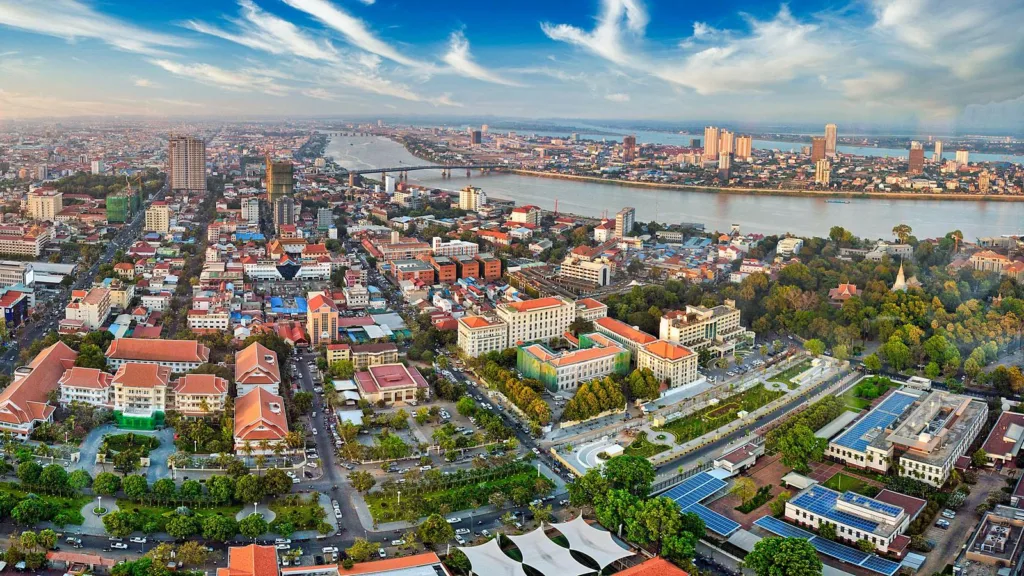
Phnom Penh from the air. Photo: allPhoto Bangkok / Unsplash.
Sub-Decree 225 sets a floor of four billion riel for Cambodia's investment route to nationality and twelve billion for the donation route, while in the 2018 law the two cite different numbered conditions.
Cambodia has two money routes to Khmer nationality, and a sub-decree signed on 1 December 2025 sets what each one asks for. On the reading below, one wants capital in a sector that sub-decree lists; the other wants three times as much, paid to the national budget. What separates them is not only the sum. Each points at a different set of the numbered conditions in the Law on Nationality, and the route with the larger figure points at one fewer.
How these texts were read, and what has not been read
Both instruments are scanned Khmer-language images with no text layer and no OCR, and they were read by someone who is not fluent in Khmer. Numerals, article numbers and numbered cross-references are legible with confidence; the legal meaning carried by that structure is a reading, and is flagged as one below. Where a reading is repeated independently by English-language sources, that is said too.
One gap matters more than the method. The Law on Nationality was amended by Royal Kram of 5 September 2025 and no published text of that amendment was located. Sub-Decree 225 refers in its own Chapter 7 to “the new Article 29” of the Law. Everything below about the Law is therefore the 2018 text as read, and the survival of those article numbers in the sub-decree’s cross-references does not establish that Articles 18 to 23 are unchanged.
The law names the routes, a sub-decree sets the floor
On this reading, Article 18 describes naturalisation as a favour of the Kingdom rather than a right of the applicant, and permits refusal at discretion. Article 19 sets the ordinary route at seven years of continuous residence and five further conditions. Four of those five are unremarkable. They cover good conduct, the absence of a conviction, a residence in Cambodia with a residence card issued under the Law on Immigration for the foreigners covered by Articles 21 and 22, and health that is not a burden on the nation. The fifth is not unremarkable. Condition five asks for Khmer language and writing, some Khmer history, evidence of living harmoniously in Khmer society and acceptance of Khmer customs.
Articles 21 and 22 carve out the money routes, and both hand the figure to the executive: each closes by providing that the amount is to be set by sub-decree. That sub-decree is No. 225, signed by Prime Minister Hun Manet and countersigned by the Deputy Prime Minister and Minister of Interior, Sar Sokha. Article 59 applies it from the date of signature. The year on that page is printed and reads 2025; the numeral for the day is handwritten, and reads 1 December. Article 58 repeals Sub-Decree No. 112, dated 30 August 2018.
Two figures, written in riel
Article 29 sets the investment floor at personal capital of 4,000,000,000 riel or more, spent on an actual project. Article 31 sets the donation at 12,000,000,000 riel or more, of clear and lawful origin, paid into the national budget through the Ministry of Economy and Finance. The two thresholds stand in a ratio of exactly three to one. That both are floors rather than fixed sums is a reading of the Khmer; it is also the reading given by the operator’s English page and by an English-language law-firm summary of the sub-decree.
Both are written in riel, and only in riel. Neither article names a dollar. The round dollar amounts that travel with this story — one million and three million — are an implied conversion at exactly 4,000 riel to the dollar, which is not a quoted rate of any date. At the National Bank of Cambodia’s official rate for 14 September 2026, 4,052 riel to the dollar, the two floors come to USD 987,167 and USD 2,961,500 when rounded to the dollar, or 1.28 per cent below the round figures.
The numbered item on one list and not the other
Articles 21 and 22 contain different numbered cross-references to Article 19.
The investment route cites conditions one, two, four, five and six. The donation route cites one, two, four and six. Condition five is the item on the first list and not the second. On the reading, the first route also asks for at least twelve full months of lawful residence in Cambodia and the second for at least six.
Which numbers each article carries is legible without reading Khmer, as the riel figures and the article numbers are. What condition five contains is the reading given above, and no English-language source was found against which to check it. What its omission does for an applicant in practice is not established.
What counts as an investment, and what can be withdrawn
Article 29 does not stop at the figure. On this reading the capital must go into a priority sector set out in the sub-decree’s annex, and into a type of project listed there, and other conditions must be met, such as tax obligations arising from the original investment. Article 30 puts that appraisal with the Ministry of Interior and requires the capital to be of clear and lawful origin. The annex runs to twelve items, among them agriculture, processing, manufacturing, tourism, high technology and financial institutions financing SMEs. Its twelfth and last is housing, in two forms: affordable housing, and housing in an area the Royal Government has designated as a priority area.
Chapter 7 deals with what can be withdrawn from someone naturalised, and is a separate regime from Chapter 6, which deals with nationality by birth and has a national committee of its own. Article 52 numbers five grounds. The numbering is on the page; what each ground contains is the reading. On that reading, the first three reach conduct after the fact — treason or collusion with a foreign country harming the national interest; acts harming sovereignty, territorial integrity and national security; and voluntarily serving a foreign state’s armed forces or holding its public office, then failing to resign when ordered to by the Royal Government. The fifth is a conviction for a felony or a misdemeanour relating to violation of the person of the King, harm to the security of the state, and acts of terrorism. The fourth stands apart from the other four, because it looks back at the application itself: obtaining Khmer nationality by fraud or by providing false information. On that fourth ground, Article 54 has the Ministry of Interior reassemble and cross-check the file the person filed when applying, summon them if needed, and — where the evidence is sufficient — report to the Prime Minister with an opinion. Article 56 has the withdrawal decided by Royal Decree on the Prime Minister’s proposal. No limitation period for that ground was found in Chapter 7.
What the operator tells applicants
Alongside the instruments sits Cambodia My 2nd Home. Its operator describes it as a ten-year visa promoted by the Ministry of Interior, running under a memorandum of understanding with the General Department of Immigration signed on 16 June 2022. The operator’s citizenship page reproduces both riel figures and converts them to the round dollar amounts.
The same page states that an applicant must hold CM2H membership for five years or more and have a company or property in Cambodia registered in their name. The review did not find that five-year membership requirement in Articles 18 to 23 of the Law as read, or anywhere in the nineteen pages of Sub-Decree No. 225. What CM2H is in law, and what the membership condition does, was not established.
What else this article does not establish
The repealed 2018 sub-decree was not located, so whether these riel figures are higher, lower or new cannot be said. Nothing read gives the filing fee — Article 26 leaves it to a joint prakas that was not located — or the number of people naturalised on either route, or the window in which those twelve and six months are counted.
What follows
The two routes differ in more than their floors, and the difference that is legible without translation is the plainest one: Article 21 cites five of Article 19’s numbered conditions, Article 22 cites four.
The rest of the file is harder to read off the page. On the reading, Article 18 makes naturalisation a favour rather than a right; Article 30 gives the Ministry of Interior the appraisal of the capital rather than a sum to check against; and Article 52(4) lets it reopen the application afterwards, on a ground for which the review found no limitation period in Chapter 7 and for which the amended Law may or may not supply one. Four billion riel and twelve billion riel are the two numbers an applicant can read without help. Article 54 describes what the Ministry does with the rest of the file, and it starts by reassembling the one he filed.
Read this article in Vietnamese
The Legation Times writes its content from published documents; nothing here is legal, tax or investment advice. Spotted an error? Send a correction request; for content rights, send a takedown request.