Germany removed its EUR 250,000 self-employment presumption in 2012
 Michael Mai

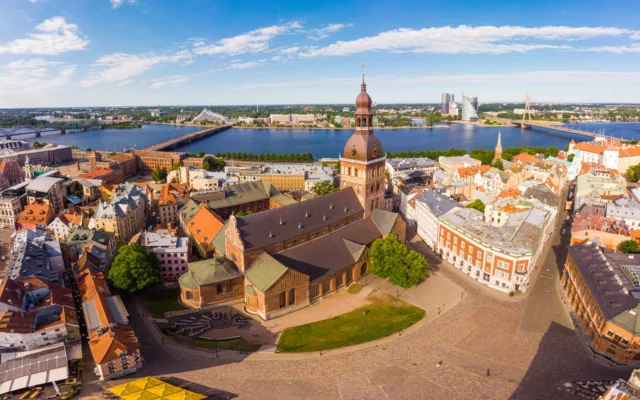
Central Berlin on the River Spree — illustration. Section 21 of Germany's Residence Act grants residence for self-employment; since 2012 it has named no EUR 250,000 benchmark.
Section 21 of the Residence Act sets no fixed investment minimum, but authorities still assess the capital committed, business viability and economic effects; Vietnamese applicants file at German missions.
Section 21 of Germany’s Residence Act provides a residence route for foreign entrepreneurs who want to be self-employed. Until August 2012 it said that an investment of EUR 250,000 and five jobs would normally satisfy two of its conditions. That sentence was deleted, and the law now names no fixed investment amount or number of jobs, although the capital committed is still one of the factors assessed.
How the presumption disappeared
The original Section 21, in force from 1 January 2005, said that its conditions of an overriding economic interest or special regional need and positive economic effects were normally met by an investment of at least EUR 1 million and 10 jobs. An amending act of 19 August 2007, effective 28 August 2007, replaced those figures with EUR 500,000 and five jobs. An act of 20 December 2008 lowered the sum to EUR 250,000 from 1 January 2009.
The act implementing the EU Highly Qualified Workers Directive, dated 1 June 2012 and in force from 1 August 2012, deleted the sentence. The Bundestag’s interior committee explained that the rule had often been treated not as a presumption but as a mandatory requirement, so that applications were refused even where the business model was in principle suitable.
A 2014 study by the German contact point of the European Migration Network, published by the Federal Office for Migration and Refugees (BAMF), states that investing as such, for example by buying property or acquiring company shares, does not entitle an investor to a residence title.
What the authorities assess instead
A permit may be granted if there is an economic interest or a regional need, the activity is expected to have positive effects on the economy, and its financing is secured by the applicant’s own capital or by a loan commitment. The authorities judge this on the viability of the business idea, the applicant’s entrepreneurial experience, the amount of capital, the effects on jobs and training, and the contribution to innovation and research. Local chambers, trade authorities, professional bodies and licensing authorities must be consulted.
Applicants over 45 should be admitted only if they have adequate provision for old age. Graduates of state or state-recognised German universities or comparable institutions, and researchers or scientists holding residence permits under Sections 18b, 18d or 19c(1) or an EU Blue Card, should receive the permit without meeting the conditions in Section 21(1), provided the business is linked to their studies or research. Skilled workers may also receive a permit to prepare a company for the duration of a publicly funded scholarship from a German business organisation or public body that secures their livelihood, up to 18 months.
The permit is issued for at most three years. After three years of self-employment, a settlement permit may be granted where the activity’s success and duration point to continued sustainable development, sufficient income supports the holder and qualifying dependent family members living with them, and the public-security and public-order condition in Section 9(2)(1)(4) is met. The general route, under Section 9, requires five years on a residence permit and further conditions. The three-year route does not apply to freelancers.
Applying from Vietnam
The German Embassy in Hanoi and the Consulate General in Ho Chi Minh City publish one checklist for the self-employment visa. It asks for a business plan including a capital requirement plan and a financing plan, an extract from the German commercial register showing the shareholders and the managing director, a CV, proof of qualifications and health insurance for at least three months. The checklist generally exempts English-language documents from translation into German, but its qualifications item asks for notarised German translations.
The self-employment visa cannot be requested through the online consular portal. In Ho Chi Minh City, self-employment applications are filed directly at the Consulate General through its appointment system rather than through the visa service provider; the embassy’s appointment guidance in Hanoi directs this category through its waiting-list system. The fee is EUR 75, paid in Vietnamese dong and not refunded if the application is refused. The foreigners authority at the intended place of residence in Germany must generally consent. The Federal Foreign Office says that national-visa procedures requiring such consent can take up to three months, occasionally longer; it gives no separate estimate for self-employment applications from Vietnam.
How many first permits were recorded
In an answer to a parliamentary question dated 5 June 2026, the federal government reported each person’s first recorded Section 21 grant within its reporting period of 1 January 2015 to 30 April 2026: 898 in 2024, 1,137 in 2025 and 285 in the first four months of 2026. Entry visas are not included. Vietnam does not appear among the 10 most common nationalities in any year from 2015 to April 2026; China leads in most years, Türkiye in 2024 and January to April 2026.
Citizenship
Since 27 June 2024 the standard residence period for naturalisation has been five years of lawful habitual residence, down from eight, subject to other statutory conditions, normally including German at level B1 and support for the applicant and dependent family members without specified social-assistance benefits, with statutory exceptions. German law no longer requires the previous nationality to be given up. A three-year fast track introduced at the same time was abolished from 30 October 2025. Whether a Vietnamese citizen keeps Vietnamese nationality is a matter of Vietnamese law.
Limits of this reading
The federal statistics do not give a figure for Vietnamese nationals. The embassy checklist’s item on old-age provision cites a provision for skilled workers rather than Section 21, and processing times specific to self-employment visas from Vietnam are not published.
Related programmes
- GermanyStart-up visa Open
The Legation Times writes its content from published documents; nothing here is legal, tax or investment advice. Spotted an error? Send a correction request; for content rights, send a takedown request.