Vietnam lets passport travellers carry gold jewellery but not bars
 Edward Nguyen
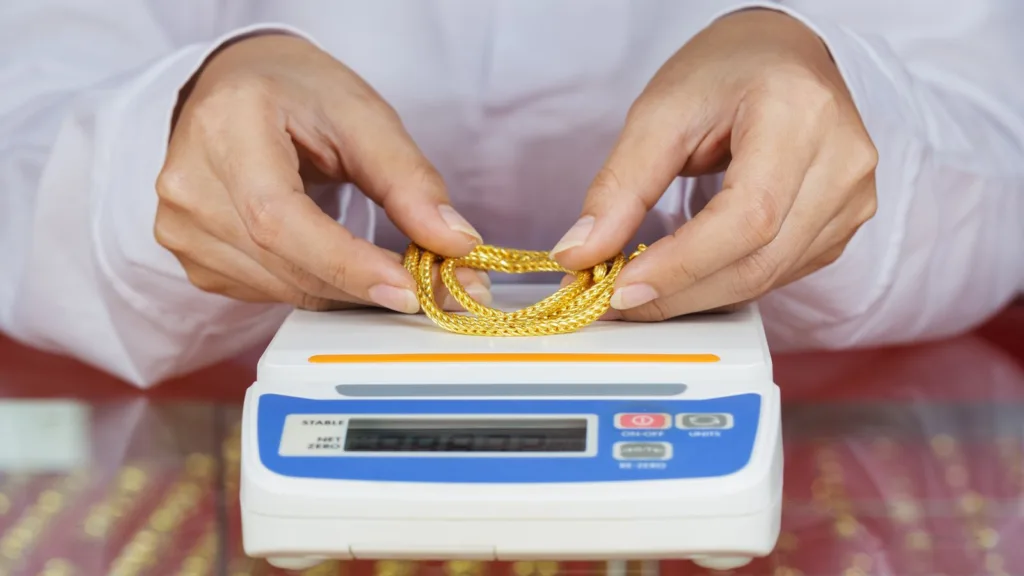
Passport travellers may not carry gold bars or raw gold in or out of Vietnam; jewellery may cross, declared from 300 g. Vietnamese permitted to settle abroad may take any gold, licensed from 1 kg in total.
A traveller crossing Vietnam’s border on a passport may carry gold jewellery and gold art objects, and must declare them to customs once their combined weight reaches 300 grams. The same traveller may not carry gold bars or raw gold at all, in either direction.
That line, drawn by the State Bank of Vietnam’s Circular 11/2014/TT-NHNN, turns first on the kind of gold and only then on its weight. Vietnamese law’s definitions of gold indicate that it also catches a bar bought abroad.
Jewellery may cross, bars may not
Under Article 2 of Circular 11/2014/TT-NHNN, Vietnamese and foreign individuals leaving or entering Vietnam on a passport are not permitted to carry gold bars or raw gold. They may carry gold jewellery and art objects; where the total weight is 300 grams or more, it must be declared to customs. No upper weight for jewellery appears in the circular, only that declaration line.
Vietnam Customs’ 2021 guidance for departing passengers repeats both rules, and Customs lists jewellery of 300 grams or more among the items that oblige a declaration on exit.
A foreign national who arrives with gold bars or raw gold must deposit them in a customs warehouse to collect on departure, or arrange to send them abroad, and bears the related costs.
The circular has been in force since 15 May 2014. The Ministry of Justice’s national legal database lists it as “partially expired”, but the only text it names as the cause is a 2015 circular that changed which copies of documents a licence file may contain; the record shows no expiry date and no text ending it in full.
No replacement was found in that database, among the titles of State Bank texts published in the Official Gazette between January 2022 and 30 September 2026, or in the repeal list of the State Bank’s 2025 gold-trading circular.
Decree 24/2012/NĐ-CP, the Government’s gold-trading decree, still provides, in an article its 2025 amendment left unchanged, that people crossing through international border gates may carry gold under State Bank rules, and the amendment keeps a State Bank licence for individuals carrying gold above the prescribed level.
How Vietnamese law classes a bar bought abroad
Vietnamese law defines a gold bar narrowly. Under Decree 24/2012 as amended by Decree 232/2025/NĐ-CP, a gold bar is gold stamped into a bar showing its weight and quality and bearing the mark of an enterprise or commercial bank that the State Bank permits to produce bars, or a bar whose production the State Bank itself organises. Raw gold is gold in blocks, ingots, granules, pieces and other forms.
A bar bought in the United States and bearing a foreign refiner’s mark is therefore raw gold in Vietnamese terms. The label does not change the result for a traveller: neither category may be carried on a passport.
Settling abroad or in Vietnam
The exceptions concern settlement. A Vietnamese citizen permitted to settle abroad may take gold of any kind (bars, raw gold, jewellery or art objects) when leaving.
A total of 300 grams up to under 1 kilogram must be declared to customs. From 1 kilogram, the person also needs a licence to carry gold on exit for settlement abroad, issued by the State Bank branch of the province or city where they reside.
The licence file contains an application; a purchase invoice or other proof that the gold was lawfully acquired or, where there is none, the person’s own written undertaking that it was; the passport, with a visa where the destination requires one; and the competent authority’s decision permitting settlement, or an equivalent document.
Documents in a foreign language must be translated into Vietnamese and notarised, or the translator’s signature certified. The branch decides within 15 working days of a complete file, must explain a refusal in writing, and a licence is valid for six months from issue.
The circular still names provincial branches, while the State Bank’s 2025 gold-trading circular directs its own filings to regional branches. Which office now issues the licence was not established.
A foreign national permitted to settle in Vietnam may bring gold of any kind on entry, declaring a total of 300 grams or more.
Penalties under two decrees
Customs penalties changed on 1 July 2026, when Decree 169/2026/NĐ-CP replaced Decree 128/2020. Its Article 11 fines a traveller who fails to declare, or wrongly declares, gold carried above the prescribed level, on a scale set by the value of the goods:
- On exit: from VND 1–3 million where the goods are worth VND 5 million to under VND 30 million, up to VND 30–50 million where they are worth VND 100 million or more and the case is not prosecuted as a crime.
- On entry: from VND 1–2 million (VND 5 million to under VND 50 million) up to VND 10–20 million (VND 100 million or more, again where there is no prosecution).
These are the amounts for individuals. Gold that need not be declared is deducted from the value, and goods properly declared are not counted.
Article 14 separately fines illegally transporting goods, cash or gold across the border, in bands from VND 5–10 million where the goods are worth under VND 30 million up to VND 60–80 million from VND 100 million where there is no prosecution, with confiscation of the goods. Those bands are stated for organisations; for an individual each is halved.
A banking-sector decree adds a further layer. Under Decree 340/2025/NĐ-CP, in force since 9 February 2026, carrying gold on exit or entry contrary to law is fined VND 80–100 million for an individual, except where the act is an administrative violation in the customs field.
The same article fines importing or exporting raw gold or gold bars without a licence VND 300–400 million, with confiscation of the gold; whether that clause reaches a traveller’s luggage is not stated. Neither customs article says whether undeclared gold bars fall under Article 11, as a failure to declare, or Article 14, as illegal transport.
Selling a foreign bar inside Vietnam
Whether a bar bought abroad can be sold in Vietnam depends on the trading rules, which Decree 232/2025 amended with effect from 10 October 2025. The decree repealed the clause giving the state a monopoly on producing gold bars, on exporting raw gold and on importing raw gold for bar production.
Enterprises and commercial banks may now be licensed to produce bars if, among other conditions, they already hold a gold-bar trading licence and have charter capital of at least VND 1,000 billion (enterprises) or VND 50,000 billion (banks).
Annual quotas and per-shipment licences to import gold bars and raw gold, which must be at least 99.5% fine, go only to those licensed producers; separate raw-gold import licences exist for certain jewellery manufacturers and for enterprises mining gold abroad. Circular 34/2025/TT-NHNN, as amended by Circular 58/2025/TT-NHNN, sets the files. Each of these routes is written for enterprises or banks.
Organisations and individuals may buy and sell gold bars only at credit institutions and enterprises licensed by the State Bank to trade them, and licensed producers and traders may deal only in bars of the type Vietnamese law defines. A licensed dealer therefore cannot buy a foreign-branded bar as a gold bar.
No text consulted provides a route for an individual to import a bar bought in the United States and sell it in Vietnam.
An individual who buys or sells gold bars with an unlicensed institution receives a warning, and a fine of VND 10–20 million on a repeat. Any gold purchase or sale of VND 20 million or more in a day by one customer must be paid through the customer’s payment account and that of the gold business.
Income from transferring gold bars is taxable personal income under the Personal Income Tax Law in force since 1 July 2026, as the Government portal quoted the Law on 30 June 2026: the Government is to set the taxable value threshold and when collection starts, and to adjust the rate.
The same article reported that the Ministry of Finance had told the Government its draft implementing decree did not yet detail collection on gold-bar transfers, and that the State Bank was amending Decree 24/2012 again. No Government text with gold in its title appeared in the Official Gazette between 9 February and 26 September 2026.
At the other end
The destination’s rules apply separately, and differ.
- United States. Customs and Border Protection (CBP) says gold coins, medals and bullion may be brought in, except items originating in or brought from Cuba, Iran, Burma and most of Sudan. Anyone entering or leaving with more than US$10,000 in currency or monetary instruments must report it on FinCEN Form 105; CBP’s list of monetary instruments begins with coins and currency and does not mention bullion. This indicates that gold bars fall outside that report; whether gold coins count as coins for this purpose was not established.
- Japan. Japan Customs requires gold bullion of at least 90% purity weighing more than 1 kilogram to be declared on the means-of-payment form, on entry or departure, and any gold brought in to be ticked on the baggage declaration whatever the quantity. Consumption tax at the standard 10% applies to imported goods in general, and Customs describes gold smuggling as a way of avoiding it, punishable by up to five years’ imprisonment, a fine of up to five times the gold’s value, or both.
- Australia. The Australian Border Force states: “An AUSTRAC [Australian Transaction Reports and Analysis Centre] declaration is not required for bullion.” Legal-tender precious-metal coins can be brought into the cross-border report at the Force’s direction where a consignment, cash included, exceeds AUD 10,000, and investment gold of at least 99.5% fineness is free of duty and GST on import. The guidance is written mainly for importers; its only instruction to passengers is to complete the Incoming Passenger Card accurately.
Cash follows its own rules: a traveller entering or leaving Vietnam must declare foreign cash above US$5,000 or its equivalent, or Vietnamese cash above VND 15 million, under Circular 15/2011/TT-NHNN, thresholds that Vietnam Customs’ 2021 guidance repeats. Carrying cash and settlement transfers are covered in a separate article, and how the evidence chain decides cross-border capital transfers is covered in another.
What this article has not established
Which State Bank office now issues the 1 kilogram licence was not established. Nor was it established which foreign documents count as permission to settle abroad, for example whether a residence permit obtained through investment does.
It was not established which penalty applies to a traveller found with undeclared gold bars, or whether a case under Article 11 of Decree 169 ends in confiscation (that article lists none; Article 14 does). Decree 169 refers to Criminal Code Articles 188 to 200 and to goods worth VND 100 million, but the criminal thresholds were not researched.
No text was found that expressly allows or forbids an individual to sell a foreign bar inside Vietnam to anyone, for instance as raw gold to a jewellery business.
Whether a threshold, start date or rate for tax on gold-bar transfers has been set since 30 June 2026 was not established, and Government texts published in the Official Gazette after 26 September 2026 were not fully checked. It was not checked which clause of Circular 15/2011 a 2022 circular amended.
For Australia, the reporting agency AUSTRAC’s own page timed out when it was opened, and Japan’s 2026 documentation rules for gold imports were not analysed for passengers.
Lead photo: Magnific.
The Legation Times writes its content from published documents; nothing here is legal, tax or investment advice. Spotted an error? Send a correction request; for content rights, send a takedown request.