Barbados House passes bill with investor route to permanent residence
 Michael Mai
Replacement Immigration and Citizenship Bills passed the House of Assembly on 27 October, and the Senate lists their first reading for 4 November. The investment floor is $5 million, in an unnamed currency.
Barbados’s House of Assembly passed an Immigration Bill and a Barbados Citizenship Bill on 27 October 2026. Under section 10 of the Immigration Bill, a non-citizen who makes a “qualifying investment” of at least $5 million in an approved national development project may, on application, be registered as a permanent resident. The Senate’s order paper lists both bills for first reading on 4 November, and neither is in force.
For a Vietnamese investor or family, as for any other applicant, the new route cannot be used yet: the bills are not law, and projects and fees are left to later Orders and regulations. Neither bill names Vietnam, so a Vietnamese applicant is a person who is not a national of a Caribbean Community (CARICOM) state. That puts any citizenship application under section 3(6) of the Citizenship Bill.
What the Immigration Bill sets for investors
Section 10 defines a “qualifying investment” as one valued at $5 million or more in a project that the Minister has designated by Order as an approved national development project. The Bill says a “project” includes a programme, fund, undertaking, asset or other initiative. The Minister may designate a project only if satisfied that it serves a public purpose and contributes significantly to the development of Barbados.
Minister of Home Affairs Gregory Nicholls pointed to areas such as water reclamation, sewage treatment, healthcare, education and housing as sectors where Barbados needed investment, Barbados Today reported. No project has been designated, and the power sits in a Bill that is not law.
Neither bill says which dollar. The unit of currency of Barbados is the Barbados dollar under the Central Bank of Barbados Act, and the Central Bank describes the rate against the US dollar as 2 to 1. This means $5 million would read as about US$2.5 million if the Barbados dollar is meant, but the text does not say so.
Points can replace part of the five years of residence otherwise required. A person with at least 180 days of lawful residence in the three years before applying can make up the gap with points, each worth six months (section 9). Time on the Barbados Welcome Stamp counts as lawful residence.
In the Third Schedule, investment of $1 million to under $5 million in an approved national development project scores 2 to 8 points, and investment in a designated private business scores 1 point for each $1 million, up to 8. Age under 50 scores 3 points.
This means a person under 50 who invests $3 million to under $4 million in an approved project earns 9 points, equal to 54 months, and about six months’ residence would bring the total to five years.
Under section 10(4) the Minister may revoke the status if the investment was misrepresented, if it is withdrawn, redeemed or disposed of before the approved period, or if the project is not completed within that period, among other grounds.
What the Citizenship Bill sets for citizenship
Registration as a citizen is discretionary. Under section 3(6), a person who is not a national of a CARICOM state, and that person’s spouse and other dependants, may be registered after lawfully residing as permanent residents for an aggregate of at least 360 days during a period of at least 1,460 days immediately preceding the application.
For nationals of CARICOM states, section 3(5) requires an aggregate of at least 270 days during a period of at least 1,095 days immediately preceding the application. Under section 2(5), which applies throughout the Act, an absence of less than six months is treated as residence.
Section 4 lets the Minister refuse registration in the interests of national security and public policy, and lists a sentence of 12 months or more and lack of means among the persons who may be refused. Section 13 says the Minister is not required to give reasons if doing so would prejudice national security or the public interest. The Citizenship Bill contains no appeal provision.
Barbados Today reported that Nicholls told the House: “This bill does not create the sale of citizenship.” The Joint Select Committee’s report records a statement that Barbados does not operate, and the bills do not create, a programme of citizenship by investment. In the texts posted, registration under section 3 does not refer to investment.
The Citizenship Act in the 1985 printing posted by the Barbados Law Courts requires a naturalising adult to have resided in Barbados throughout the 12 months before applying and for at least five years in the seven years before that.
How the text changed
Barbados Today reported that the Government withdrew the earlier bills, first read on 29 April 2026, and introduced replacement bills on 27 October, after the Joint Select Committee’s report, laid on 11 August. The provisions changed across three texts: the Gazette text of 5 May, the committee’s amended drafts of 11 August and the text posted for 27 October.
| Gazette, 5 May | Committee drafts, 11 August | Text posted for 27 October | |
|---|---|---|---|
| Investment route to permanent residence | None | None | Section 10: $5 million or more in an approved national development project |
| Other grounds | Retired persons with sufficient financial resources; 10 points, including points for property and assets | The same, and a ground for Welcome Stamp holders | Five years’ residence, or 180 days plus points; no retired-person ground; Welcome Stamp time counts as residence |
| Citizenship, CARICOM nationals | 180 days within 730 | 270 days within 1,095 | 270 days within 1,095 |
| Citizenship, other nationals | 270 days within 1,095 | 360 days within 1,460 | 360 days within 1,460 |
| Citizenship acquired by investment in another CARICOM state | Not addressed | Excluded from the shorter route (clause 4(6)) | No exclusion in the text |
No investment route appears in the Gazette text, the committee’s report or its appended drafts, so the replacement Immigration Bill is the first text read that contains one. In the Citizenship Bill, the text posted no longer limits CARICOM nationals to those by birth, descent or naturalisation and defines “national of a Member State” by reference to Article 32(5)(a) of the First Schedule to the Caribbean Community Act, Cap. 15.
Where the bills stand
Parliament’s bill pages for the Immigration Bill and the Citizenship Bill show both passed on 27 October and give 29 October as the Senate notice date, while the Senate’s order paper gives 28 October.
The Senate’s order paper, for Wednesday 4 November at 11.00 a.m., says both bills were published in the Official Gazette on 30 October. As at 3 November the bill pages show no Senate stage beyond the notice.
Each Act would come into operation on a date fixed by Proclamation. Fees would be set by regulation and designations by Order, and neither bill states an amount of fee or a start date.
What this article has not established
The text the Senate will read is not established. The Official Gazette of 30 October, where the Senate’s order paper says the bills were published, was not found online, and the House texts posted by Parliament carry no House stamp or list of amendments. The Hansard and Minutes of 27 October had not been posted on 3 November, so the Minister’s words are as the press printed them.
The bills do not state the currency of their amounts, the projects to be designated, the meaning of the approved period in section 10(4), the fees or the forms. Section 10 does not say whether an investor must reside in Barbados before or after registration.
On citizenship, the text does not say whether the 1,460 days is a window in which the 360 days must fall or a minimum period of permanent residence, or how many of the 360 days require presence in Barbados. The Caribbean Community Act was not read, so it is not established whether its definition of a national of a Member State excludes persons who acquired CARICOM nationality through investment.
The Senate’s timetable beyond the first reading, and any amendment there, are not established. The Citizenship Act text read is the 1985 printing, and later amendments were not checked. Vietnamese law on keeping Vietnamese nationality on acquiring Barbadian citizenship was not examined.
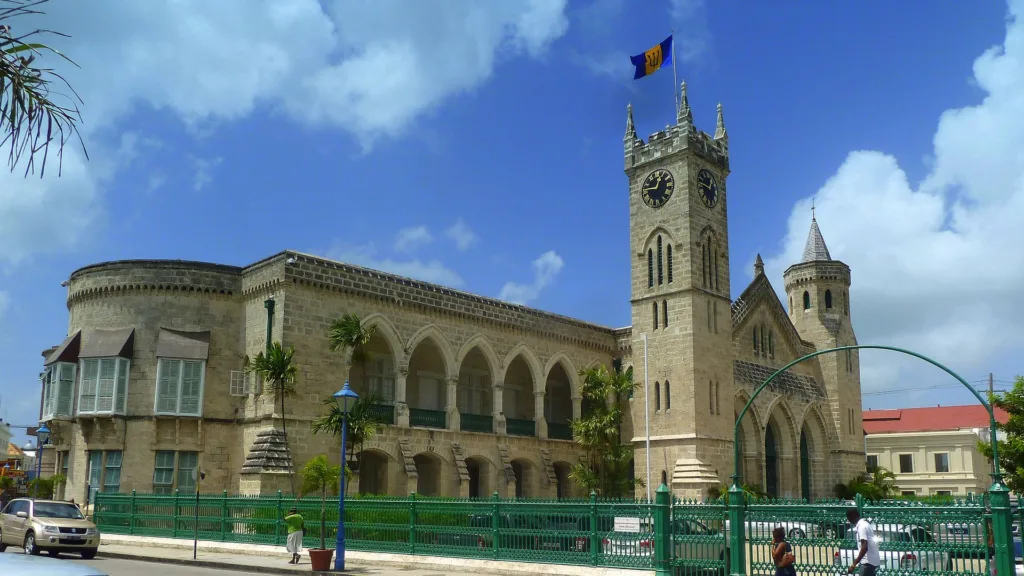
Lead photo: giggel, Wikimedia Commons, CC BY 3.0.
The Legation Times writes its content from published documents; nothing here is legal, tax or investment advice. Spotted an error? Send a correction request; for content rights, send a takedown request.