UK prime minister raises rejoining the EU, but no rule has changed
 Michael Mai
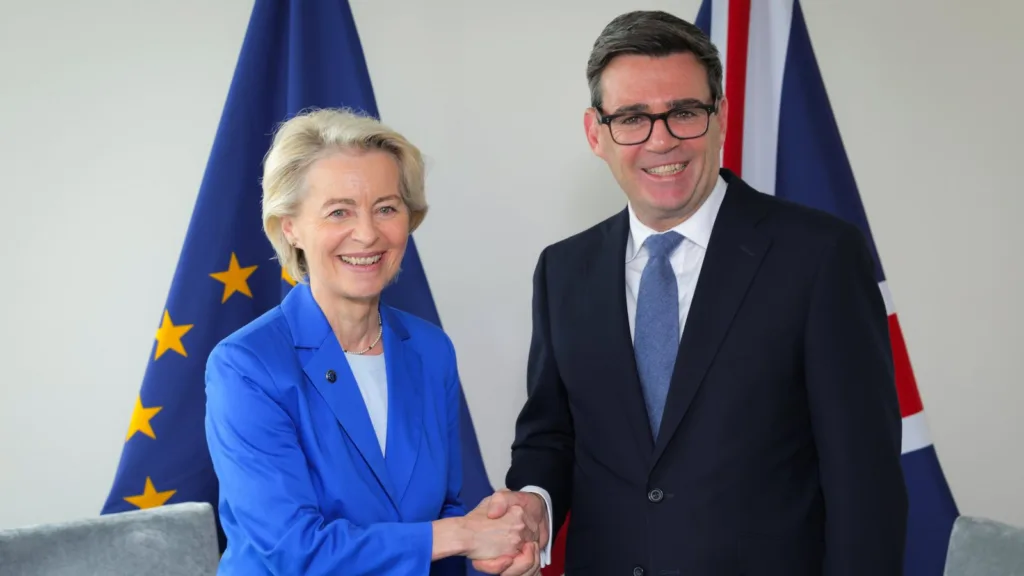
Ursula von der Leyen and Andy Burnham in New York on 22 September 2026, meeting ahead of the UK–EU summit. Burnham has raised rejoining the EU, but no rule has changed. Photo: European Commission, © European Union 2026, CC BY 4.0.
Burnham wants a "serious dialogue" on long-term options after the 20 November UK–EU summit. No residence or travel rule has changed. Rejoining means Article 49; he backs a pledge of an election and referendum.
Prime Minister Andy Burnham told MPs on 12 October that, after the UK–EU summit his office has announced for 20 November, Britain should “set up a serious dialogue about the different options” for its long-term relationship with the European Union. On 30 September he had told the BBC that rejoining was among the options the government “could look at”. Answering a question, he said: “There is no proposal for a referendum; there is no deal on the table.”
For a Vietnamese family, none of this changes a rule today. The statements describe a dialogue still to come. On TLT’s reading, nothing in the conference speech, the Commons statement or the petition debate touches the Innovator Founder or Global Talent routes, or the position of a Vietnamese-born British citizen; no change to UK immigration routes was announced. Rejoining would go through the EU’s accession procedure. The Prime Minister has also said he stands by words committing him to a general election and a full referendum before seeking to join.
What the Prime Minister has said
In his Labour conference speech in Liverpool on 29 September, according to the party’s transcript, Burnham said he would “take the opportunity around the summit” to set out “what I believe the different options are for Britain’s long-term relationship with our European partners” and “see if we can find consensus around one”.
On BBC Radio 4’s Today programme the next day, as reported by the Guardian, he said the UK could stay as it is, look at a customs union or the single market, “or we could go all the way”. He told the BBC’s Chris Mason that “to leap back to a proposal and a referendum on it wouldn’t be the right thing to do right now”. Asked whether a future Labour manifesto could promise an in-out referendum, he said: “Yes, things are possible.”
In the Commons on 12 October he put the summit first: “Our immediate priority is securing a successful outcome at the summit”. The dialogue on options would follow, and “the British public will be the boss”.
He told MPs he was “not prepared to revisit the red lines in our manifesto”, which he said “include freedom of movement”. Labour’s 2024 manifesto says “Britain will stay outside of the EU” and promises “no return to the single market, the customs union, or freedom of movement”. On TLT’s reading, the red lines govern this Parliament while the options concern the longer term; the Prime Minister has not put it in those words.
The Conservative MP Sir Edward Leigh asked him to endorse a statement, in Leigh’s own words, that included the sentence “I give an absolute commitment that I will not seek to join the EU unless there is a general election first and I offer the British people a full referendum”. Burnham replied: “I stand by every single one of those words.”
What the government said in January
On 7 January 2026, under the previous prime minister, the Cabinet Office answered a petition calling on the UK to apply to rejoin: “The UK will not be rejoining the EU.”
The petition, with 111,687 signatures, was debated in Westminster Hall on 12 October. Asked by the SNP’s Pete Wishart whether rejoining was “an option” and how it would be considered, the Cabinet Office minister Mark Ferguson said he would not “go beyond what the Prime Minister said this afternoon”; later he said the Prime Minister “will lay out options … around the summit in November”. The debate ended with the House agreeing a motion that it “has considered” the petition; on TLT’s reading, a motion in that form decides nothing.
What Brussels has said
In a report on 30 September the Guardian quoted a European Commission spokesperson: “It is for the UK government to set out how it wishes to develop its relationship with the EU going forward. We remain open to engaging on the options it may put forward.” The same report said unnamed EU officials had told British counterparts the UK was welcome to join the customs union or the single market through the European Economic Area; the paper added that single market membership means accepting free movement of people.
The 20 November summit
The summit date comes from the UK government: Burnham will meet António Costa, President of the European Council, and Ursula von der Leyen, President of the Commission, in Brussels on 20 November. In a joint statement of December 2025 the two sides set the aim of concluding a youth experience scheme, a food (sanitary and phytosanitary) agreement and a link between their emissions trading systems by this summit; on 12 October the Prime Minister told MPs the three deals were still “on the table”, and none is in force.
How rejoining would work
Article 50(5) of the Treaty on European Union, in the treaty text as published by the European Parliament’s research service, provides: “If a State which has withdrawn from the Union asks to rejoin, its request shall be subject to the procedure referred to in Article 49.” As the European Parliament’s fact sheet and the Commission describe that procedure, the application goes to the Council, which asks the Commission for an opinion; negotiations open only on a unanimous decision of EU governments; the accession treaty needs the European Parliament’s consent and the Council’s unanimous approval; and every member state and the applicant must ratify it under their own constitutional rules.
What stays in force
British citizens, including those who naturalised, remain bound by the Schengen 90/180-day rule; answering a point on haulage on 12 October, Ferguson said “all UK nationals are bound” by it. The EU’s Entry/Exit System registers non-EU nationals on short stays, which on TLT’s reading includes British citizens. The EU’s travel authorisation for visa-exempt nationals, ETIAS, “is currently not in operation”; on TLT’s reading it will apply to British travellers when it starts.
Nothing said this month touches residence rights under the 2019 Withdrawal Agreement. They cover UK nationals who were living in an EU member state under EU law before 31 December 2020 and have continued to live there, and EU citizens in the UK on the same terms; holders keep them for life unless they cease to meet the conditions, and permanent residence is lost only through more than five consecutive years’ absence.
The Innovator Founder and Global Talent routes are UK immigration rules, outside any EU arrangement. TLT has set out separately how EU and UK visa texts now treat investor citizenship.
What this article has not established
TLT found no terms of reference, lead department, method or timetable for the options exercise; the only timing on record is “around the summit”, and the BBC reported no detail on how consensus would be measured. The list of options appears only in BBC interviews as reported, not in an official text. The Commission’s response is attested only through the Guardian, and TLT could not confirm the 20 November date on an EU institution’s website. Article 49 itself was not read on EUR-Lex; its procedure is taken from the European Parliament’s and the Commission’s descriptions. TLT did not check for other changes to the immigration rules this week, and found no published start date for ETIAS.
The Legation Times writes its content from published documents; nothing here is legal, tax or investment advice. Spotted an error? Send a correction request; for content rights, send a takedown request.