A family office alone brings no residence in Singapore or Dubai
 Edward Nguyen

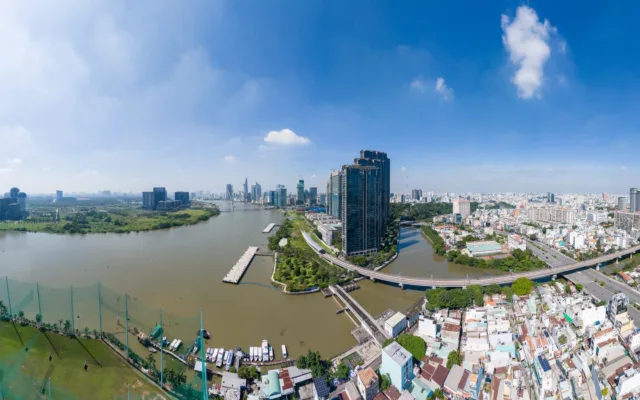
The Helix Bridge at Marina Bay, Singapore. A family office can earn fund tax exemptions but gives no residence by itself. Photo: Magnific.
Singapore's tax schemes start at S$20 million, and permanent residence through a family office at S$200 million. Dubai's DIFC asks for USD 50 million in family net assets; residence comes via investor visas.
Setting up a family office, a company that manages a family’s money, gives no right to live in Singapore or Dubai. Singapore’s tax exemptions for a family office’s fund start at S$20 million in designated investments, and permanent residence through a family office at S$200 million. Dubai’s financial centre requires USD 50 million in family net assets; residence comes through separate Golden Residency categories. On TLT’s reading, a Vietnamese citizen setting up either company makes an outward investment.
Singapore: tax exemptions with conditions
The Monetary Authority of Singapore (MAS) administers the fund tax schemes under sections 13O, 13OA and 13U of the Income Tax Act, which exempt income from designated investments of funds managed from Singapore, including by family offices, subject to conditions. A MAS circular of 31 July 2026 sets the conditions for new family-office awards approved from 1 August 2026.
The fund must hold at least S$20 million in designated investments under section 13O or 13OA, or S$50 million under section 13U; investments in the family’s own operating businesses do not count. The family office must employ two or three investment professionals respectively — portfolio managers, analysts or traders spending more than half their time on the work — at least one from outside the family, each paid more than S$3,500 a month and resident in Singapore for tax. A fund may apply with one fewer and must reach the full number by the end of its first basis period; if it does not, the award is revoked from its start date. Local spending must reach S$200,000 for funds below S$250 million, S$500,000 up to S$2 billion and S$1 million above that, of which at least S$300,000 and S$500,000 respectively must be spent with Singapore contracting parties. By the end of its first full year of assessment, the fund must invest the lower of 10% of its designated investments or S$10 million across three permitted classes: listings on approved exchanges, products distributed by MAS-licensed institutions (other than equities listed outside approved exchanges), and unlisted Singapore operating companies with a substantive presence there. It must also keep a private banking account with a MAS-licensed institution and be approved by MAS.
The Act allows no new approvals after 31 December 2029, and the circular says the Government will review the schemes before then; an award already granted lasts for the life of the fund while its conditions are met. More than 2,000 single-family offices held these incentives at the end of 2025, according to MAS.
No licence, but notice and bank checks
A family office managing only the family’s money does not need a fund-management licence. Since 15 June 2026 a class exemption requires it to be incorporated in Singapore, to hold, for itself and each fund vehicle, an account with a MAS-licensed bank, to notify MAS within 14 days of starting business and to file an annual return; existing offices have until 15 June 2027. Under the exemption, MAS says the banks carry out the anti-money-laundering checks; for tax-incentive applications, MAS also screens applicants against databases. MAS has told Parliament that six family-office funds lost their incentives over the 2023 money-laundering case (July 2024), that two more linked to individuals under United States sanctions had lost theirs (November 2025), and that about 3% of some 1,300 applications over three years were rejected.
Singapore residence: S$200 million
The family office itself gives no residence. Its principals can apply for permanent residence under Option C of the Economic Development Board’s Global Investor Programme. That requires a Singapore family office with at least S$200 million under management, of which S$50 million must be brought into Singapore at approval-in-principle and invested in Singapore-listed equities within 12 months of final approval, and a principal with at least S$200 million in net investible assets and a five-year track record. To renew the re-entry permit, the office must have added five family-office professionals in legal, tax, investment or philanthropy roles, at least three of them Singapore citizens, and either the applicant, or all the dependants who obtained permanent residence with them, must have lived in Singapore for more than half the time. The fee is S$20,000 and processing takes about 12 months. The government described Option C as open in February 2026; about 10% of some 450 people granted permanent residence through the programme between 2015 and 2025 came through it. Foreign staff need Employment Passes or the ONE Pass. The Employment Pass requires a minimum salary of S$5,600 a month, S$6,200 in financial services, rising with age, and S$6,000 and S$6,600 for new applications from 1 January 2027, plus the COMPASS points test.
Dubai: USD 50 million in the financial centre
The Dubai International Financial Centre’s Family Arrangements Regulations, in force since 2023, replaced its single-family office regime with a family office that the Registrar licenses; the application must explain the family’s source of wealth and the checks made on source of funds. The family must have a net asset value of USD 50 million, measured at market value or, where that cannot be established, book value. Serving more than one family by way of business needs authorisation from the financial regulator. Abu Dhabi Global Market’s rules have set USD 10 million in family net assets since May 2025, confirmed in its April 2026 rules, down from USD 30 million in liquid assets under the 2024 rules.
The UAE levies no income tax on individuals, and investment income a person earns for their own account, without a licence, falls outside corporate tax. The family-office company is a different matter. Corporate tax is 0% on the first AED 375,000 of taxable income and 9% above. The Federal Tax Authority’s June 2026 guide says a family-office company is unlikely to meet the conditions for tax transparency and is then taxed on all its income, including fees. A free-zone family office gets 0% on its management services only if a UAE financial regulator supervises them, although a free-zone vehicle that holds shares for investment can qualify, provided it meets the qualifying-free-zone-person conditions, including adequate substance in the UAE. The authority’s public clarification CTP008, published in 2025, adds that family ownership does not change the treatment. A family foundation that holds the assets, as distinct from the office company, can apply to be treated as tax-transparent if it meets Article 17 of the corporate tax law and Ministerial Decision 261 of 2024.
UAE residence: AED 2 million
No official text TLT read names a family office as a ground for residence. The Federal Authority for Identity, Citizenship, Customs and Port Security grants ten-year Golden Residency to investors with AED 2 million in an investment fund or bank deposit, in company capital, as a partner’s share or in property, or whose company pays AED 250,000 a year in federal taxes. The nearest route for a family office is the company-capital category, and TLT found no text saying whether a family-office company qualifies. The federal portal u.ae gives five years for the property route; the issuing authority’s page, updated more recently, says ten. TLT has covered the Golden Visa separately.
The Vietnamese side
Vietnam’s Investment Law 143/2025/QH15 has been in force since 1 March 2026. Decree 103/2026/NĐ-CP lists individuals of Vietnamese nationality as outward investors, except those barred under Article 17(2) of the Enterprise Law. A project of VND 7 billion or more, or in a conditional sector such as securities, needs a certificate from the Ministry of Finance; below VND 7 billion and outside those sectors, the investor only registers the foreign-exchange transaction. At VND 1,600 billion or more, the Prime Minister must approve first. To obtain the certificate, an individual investor must also show a tax-authority confirmation that they have met their tax obligations. All transfers must pass through an outward-investment capital account at a licensed bank in Vietnam (Decree 103/2026), and the first foreign-exchange registration must be done before any money leaves (Circular 34/2026/TT-NHNN). On TLT’s reading, a Vietnamese citizen setting up a Singapore or Dubai family-office company or fund company is investing abroad under these rules. Subscribing to a third-party fund falls under a separate provision for which the Law says the Government will issue detailed rules; TLT did not find them.
What this article has not established
TLT did not find an Inland Revenue Authority of Singapore guide on these schemes, whether the schemes will continue after 2029, which Employment Pass salary band applies to family-office staff, or any statement on Option C after February 2026. It did not find any DIFC amendment after 2023, did not consult the official Arabic text of the UAE corporate tax law, whose federal portal returned an access error, and did not establish whether a family-office company can use the UAE company-capital route. On the Vietnamese side, it did not find the detailed rules for investing through foreign funds or establish whether a family investment vehicle falls within the conditional securities sector.
The Legation Times writes its content from published documents; nothing here is legal, tax or investment advice. Spotted an error? Send a correction request; for content rights, send a takedown request.