Vietnam’s FTSE upgrade: what it opens for investors in its shares
 David Le
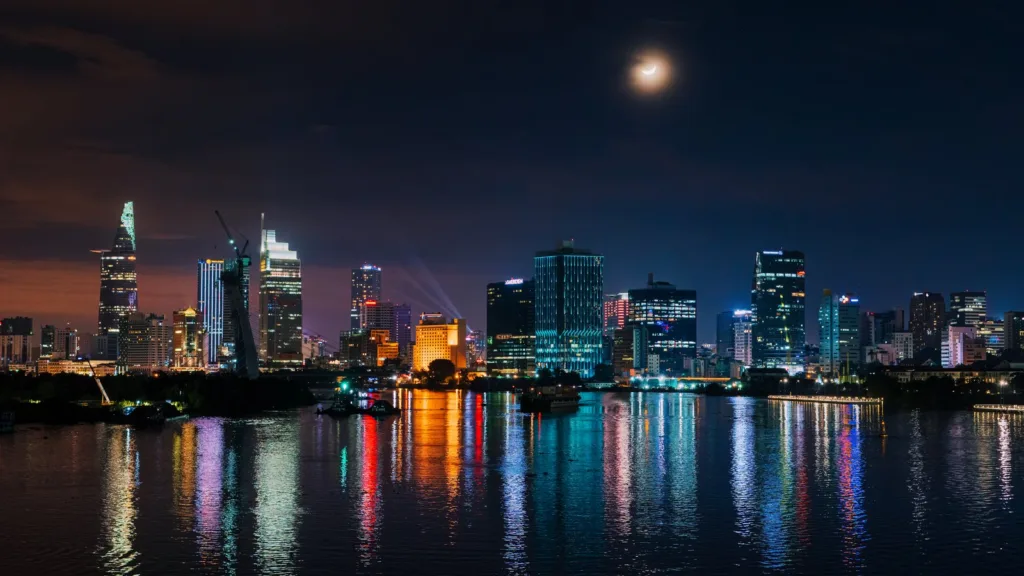
Central Ho Chi Minh City on the Saigon River — illustration.
Vietnam's new FTSE status took effect on 21 September, the government says, with the first of four inclusion steps; FDI disbursed in January to August was the highest for that period in five years.
FTSE Russell’s reclassification of Vietnam from frontier to Secondary Emerging took effect on 21 September 2026, the government says, and Vietnamese stocks now enter FTSE’s global indices in four steps to September 2027. Twenty-seven stocks listed in Ho Chi Minh City are eligible for the FTSE Global All Cap index. The change follows a set of market reforms introduced since late 2024.
What changed on 21 September
FTSE Russell announced the reclassification on 7 October 2025 and made it conditional on a review of whether foreign funds could trade through global brokers. Its interim review, published on 7 April 2026, confirmed the 21 September date. Vietnam’s government reported that the new status took effect that day, after a ceremony in Hanoi on 18 September.
FTSE adds Vietnam’s weight in four tranches: 10% in September 2026, 20% in March 2027, 35% in June 2027 and 35% in September 2027. It says the phased approach is designed to ensure an orderly transition and “manage the anticipated capital inflows”, and that it will check that index-tracking funds can follow each change before the next tranche. At full inclusion, FTSE projects Vietnam’s weight at 0.31% of its Emerging index.
The 27 stocks eligible for the Global All Cap include Vietcombank, Vingroup and Vinhomes among large companies, and BIDV, Hoa Phat and VPBank among mid-sized ones.
The reforms behind the upgrade
- No pre-funding: since 2 November 2024, foreign institutions can place buy orders without holding the full funds in advance, under Finance Ministry Circular 68/2024.
- New trading system: the KRX system went live on 5 May 2025.
- Foreign-ownership caps: under Decree 245/2025, in force since 11 September 2025, a company that has notified a cap on foreign ownership may only raise it.
- Global brokers: Circular 08/2026, in force since 3 February 2026, set up trading through global brokers and removed the list limiting which stocks could be bought without pre-funding.
- Central counterparty: a clearing company has been established and is due to go live in early 2027.
Capital and investors
The number of foreign trading accounts rose from 50,188 at the end of 2025 to 52,633 at the end of August 2026, according to the Vietnam Securities Depository and Clearing Corporation. In the week before inclusion, foreign investors were net buyers of VND 2,686 billion on the Ho Chi Minh City Stock Exchange, including VND 1,277 billion on the rebalancing day of 18 September, when they accounted for 40% of the value bought.
Foreign direct investment has also risen. In the first eight months of 2026, registered foreign investment, including capital contributions and share purchases, reached USD 40.63 billion, up 55.4% on a year earlier, and disbursed FDI was estimated at USD 17.25 billion, up 12%; the government’s news portal describes it as the highest eight-month figure in five years.
For the year to 25 September, foreign investors remained net sellers on the exchange, by about VND 93,900 billion, including VND 2,866 billion in the first week of inclusion.
What comes next
The second tranche is scheduled for March 2027, and FTSE publishes its next annual country classification on 6 October 2026. MSCI, the other major index provider, still classifies Vietnam as a frontier market; its June 2026 review of market accessibility credited the global-broker model and the planned central counterparty.
For investors, the upgrade places Vietnamese shares in benchmarks followed by funds that track emerging-market indices, with each step through 2027 tied to how smoothly the previous one is absorbed.
The Legation Times writes its content from published documents; nothing here is legal, tax or investment advice. Spotted an error? Send a correction request; for content rights, send a takedown request.