EU and UK visa texts now target investor citizenship, not just abuse
 Edward Nguyen
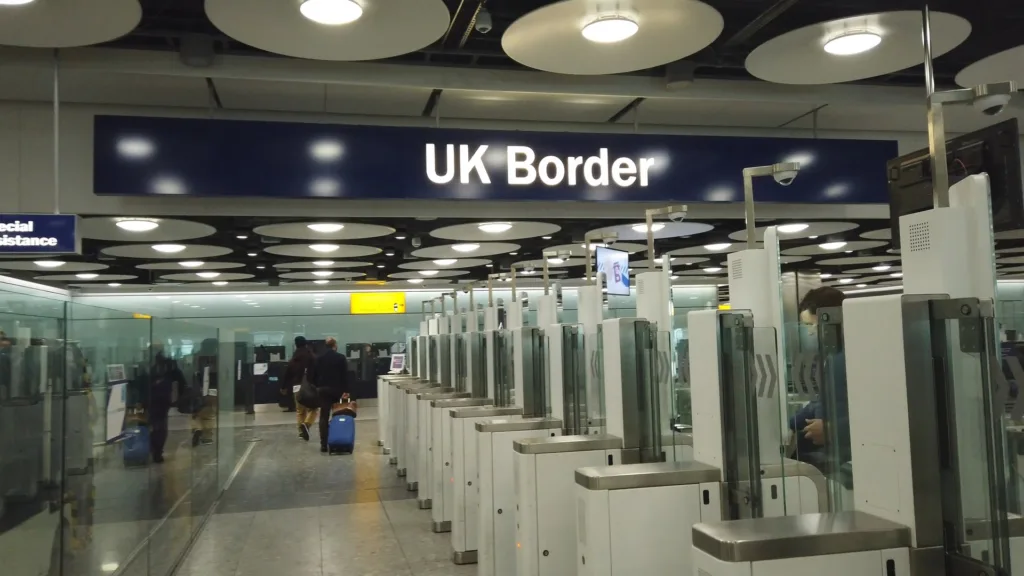
The UK Border e-gates at Heathrow Airport, London, photographed in 2019 — illustration. The UK imposed a visa requirement on Saint Lucian nationals from 5 March 2026.
The EU cited Vanuatu's scheme failures in 2022; the UK cited abuse in Dominica and Vanuatu in 2023 and inherent risk in Saint Lucia in 2026, while Ireland's announcement cited alignment.
Since 2022, the Schengen area, the United Kingdom and Ireland have withdrawn visa-free travel from nationals of Vanuatu, Dominica or Saint Lucia, which grant citizenship for investment. The EU in 2022 and the UK in 2023 cited failures in how particular schemes were run. The EU’s 2025 law targets grants without a genuine link; the UK’s 2026 memorandum calls investor citizenship inherently high-risk and also cites asylum concerns. Ireland cited alignment.
What has been withdrawn, and where
The European Commission suspended visa-free travel to the Schengen area for holders of ordinary Vanuatu passports issued from 25 May 2015, with effect from 4 May 2022. The suspension was widened to all Vanuatu nationals from 4 February 2023, and Vanuatu was moved to the list of countries whose nationals need a visa with effect from 3 February 2025. Iceland, Norway, Switzerland and Liechtenstein apply the measure as part of the Schengen rules; Ireland does not take part.
The United Kingdom imposed a visa requirement on nationals of Dominica and Vanuatu at 15:00 on 19 July 2023, and on nationals of Saint Lucia on 5 March 2026, with a transition period to 16 April 2026. Ireland imposed visa requirements on nationals of Dominica and Vanuatu from 7 March 2024.
The consolidated EU visa list of 30 December 2025 records no suspension for Antigua and Barbuda, Dominica, Grenada, Saint Kitts and Nevis or Saint Lucia. The documents examined for this article record no UK or Irish visa requirement for Antigua and Barbuda, Grenada or Saint Kitts and Nevis.
2022: the Commission’s case against Vanuatu
The Commission’s implementing regulation of 27 April 2022 relied on the ground of an increased risk to public policy or internal security. Its reasons were specific to how Vanuatu ran its schemes.
The schemes required no residence or physical presence in Vanuatu, applications were handled by agencies outside the country, and no physical interview was required. Applications were processed within very short deadlines, and Vanuatu had granted citizenship to persons under criminal investigation, including people listed on Interpol’s databases. Vanuatu had issued more than 10,500 passports under the schemes by March 2021 and had rejected one application by the end of 2020. Successful applicants could also apply to change their identity.
The regulation records that the Commission raised these concerns with Vanuatu in October 2017, November 2019, June 2020 and March 2021. It concludes: “The manner in which the said schemes are being implemented constitutes a circumvention of the Union short-stay visa procedure and the assessment of security and migratory risks it entails.”
2023: the United Kingdom points to abuse
The UK’s explanatory memorandum to the rule change of 19 July 2023 gave one sentence for Dominica and Vanuatu: “Careful consideration of Dominica’s and Vanuatu’s operation of a citizenship by investment scheme has shown clear and evident abuse of the scheme, including the granting of citizenship to individuals known to pose a risk to the UK.”
The same change imposed visas on Honduras, Namibia and Timor-Leste for different reasons, set out separately: asylum claims by visitors, and visitors who were not genuine.
2024: Ireland cites alignment
Ireland’s Department of Justice announced its decision on 4 March 2024. The Minister, Helen McEntee, said: “This is a carefully considered decision taken which will bring Ireland into closer alignment with the visa regime in the United Kingdom and the Schengen area.”
The announcement does not mention citizenship by investment. It notes that relatively few nationals of Dominica, Honduras and Vanuatu travel to or live in Ireland.
2025: the EU writes the scheme into its law
Regulation (EU) 2025/2441, in force since 30 December 2025, added a new ground for suspending visa-free travel: the operation by a visa-exempt country of an investor citizenship scheme that grants citizenship for pre-determined payments or investments to a person without any genuine link to that country. Unlike some other grounds, it carries no statistical threshold.
Its recital 7 says: “While the Union respects the right of sovereign countries to decide on their own naturalisation procedures, visa-exempt third countries should be deterred from using visa-free access to the Union as a tool for leveraging individual investment in return for citizenship.” It also cites the security risks of weak checks, such as money laundering and corruption.
According to a statement by Antigua and Barbuda’s government, set out in an earlier article, the Commission wrote on 25 June 2026 asking it to phase out its programme by 1 June 2028, and Dominica, Grenada, Saint Kitts and Nevis and Saint Lucia received similar letters. In the EUR-Lex records checked on 25 September 2026, the current consolidated text of the EU visa list dates from 30 December 2025, and the only 2026 suspension located concerns Georgia’s diplomatic, service and official passports.
2026: the United Kingdom points to the practice
The memorandum to the change of 5 March 2026 gives two reasons for Saint Lucia. The first is asylum: 360 Saint Lucian nationals claimed asylum in the UK between January 2022 and December 2025, 128 of them at the port of entry, and 222 were receiving asylum support at the end of December 2025.
The second is the scheme. The memorandum states: “St Lucia also grants Citizenship by Investment, a practice which is inherently high-risk.” It adds: “Whilst we recognise and welcome the steps taken by the St Lucian government over the last year to reduce the risks associated with its Citizenship by Investment programme, the UK continues to experience unsustainable risks.”
It attributes those risks largely to the historic sale of high volumes of citizenships, citing around 5,642 applications to the Saint Lucian programme in 2023-24, a 423 per cent annual increase, and says the growth coincided with more people detected using Saint Lucian passports to reach the UK and then claim asylum or work illegally. It states that Saint Lucia’s visa status will be kept under review.
Limits of this reading
This article reads the texts of the EU, the United Kingdom and Ireland. It does not examine other European states, does not describe the Commission’s letters beyond Antigua and Barbuda’s account, and makes no forecast about further suspensions.
The Legation Times writes its content from published documents; nothing here is legal, tax or investment advice. Spotted an error? Send a correction request; for content rights, send a takedown request.