How the Trump–Xi meeting bears on cross-border capital flows
 Edward Nguyen
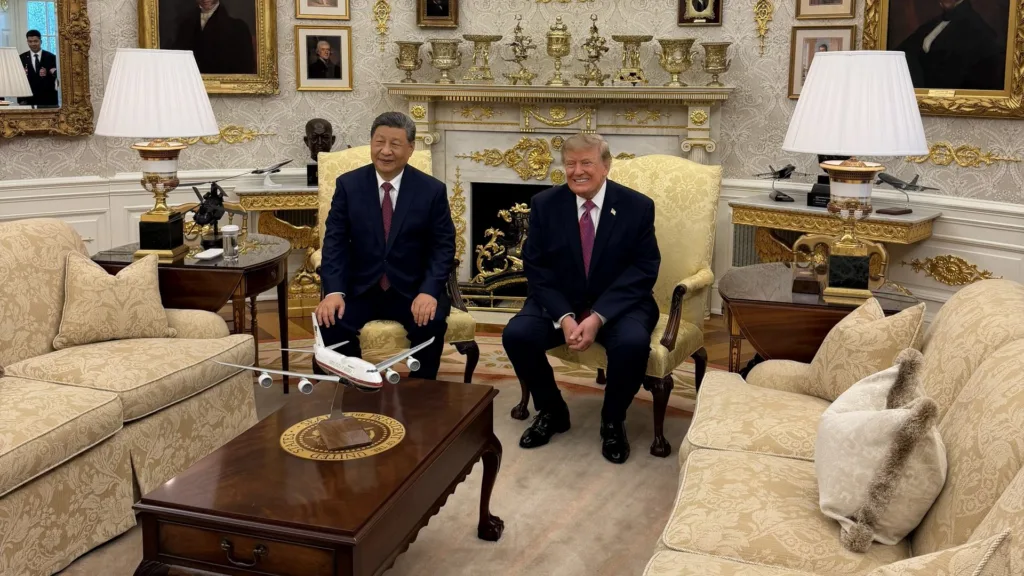
Xi Jinping and Donald Trump in the Oval Office at the White House on 24 September 2026. China's readout of the talks that day does not mention investment or capital.
China's latest foreign ministry readout of the 24 September 2026 talks between Xi Jinping and Donald Trump reports a joint arrangement between the two countries but gives no detail of what was agreed.
Xi Jinping and Donald Trump held talks at the White House on the morning of 24 September 2026, Washington time. China’s account of the talks says the two trade teams reached a new arrangement but does not give its terms. None of the official texts read for this article, as published by 08:47 on 25 September 2026, Vietnam time, sets out a rule on investment or on moving capital between the two countries.
What the texts answer and what they do not
For an investor, the question is whether the meeting changed the terms on which money moves between the United States and China. The texts reviewed here do not show such a change. They also do not establish the meeting’s effect on actual capital flows.
What the Chinese readout says
China’s foreign ministry published its account of the talks at 04:26 on 25 September 2026, Beijing time. It says Xi told Trump that the two economic and trade teams had held a new round of consultations and reached a new joint arrangement, which he called good news for industry, ordinary people and the global economy. The readout does not describe what the arrangement contains.
According to the same readout, Trump said the teams had achieved new results and that the two sides should keep talking to reach a better agreement. The leaders also discussed artificial intelligence, Taiwan, the Middle East, Ukraine and the Korean peninsula.
The readout does not use the Chinese words for investment, capital, finance or visa. Nor does it mention the trade and investment boards the two leaders created in May 2026.
At 08:41 on 25 September 2026, Vietnam time, or 21:41 on 24 September in Washington, the White House fact sheet index listed no document on the talks. At 08:47 Vietnam time, the first page of news releases of China’s Ministry of Commerce listed the foreign ministry’s account of the talks and Xi’s speech, and no text of the new arrangement.
The truce extension announced before the talks
Treasury Secretary Scott Bessent announced an extension in an interview with Fox News Channel on 23 September 2026, reported by NBC News. He said: “We will extend what we call the ‘Busan Agreement’ — the economic détente between the two countries that was scheduled to end on Nov. 10 — that is going to be extended until Jan. 10.” The extension he announced would run to 10 January 2027.
At the Chinese foreign ministry’s briefing on 24 September, held in Beijing before the talks, a Reuters reporter noted that China had not yet published anything on the extension and asked whether it agreed. The spokesperson, Guo Jiakun, said: “On the China-US economic and trade consultations, I suggest you ask the competent Chinese authorities.”
The Chinese readout does not say whether the new joint arrangement is this extension.
China’s commerce ministry, in a statement of 20 May 2026, describes a joint arrangement reached in Kuala Lumpur in October 2025 that suspended measures until 10 November 2026. It names the US reciprocal tariff of 24 per cent and China’s countermeasures, a US export-control rule known as the 50 per cent rule and related Chinese measures, and US measures from a Section 301 investigation into maritime, logistics and shipbuilding, with China’s countermeasures. The ministry presents these items as examples, not as a complete list.
Bessent’s Busan Agreement was scheduled to end on the same date. The texts reviewed here do not establish whether the two names refer to the same measures, and the official material reviewed does not specify what the extension covers.
The suspension paragraph identifies tariffs, export controls, Section 301 measures and related Chinese countermeasures. It does not specify a provision on investment or on transferring capital.
The body created for investment
The White House fact sheet of 17 May 2026 on Trump’s visit to Beijing says: “As the cornerstone of this historic agreement, President Trump and President Xi chartered two new institutions to optimize the bilateral economic relationship: the U.S.-China Board of Trade and the U.S.-China Board of Investment.”
It describes their roles in two sentences: “The Board of Trade will allow the United States Government and the Government of China to manage bilateral trade across non-sensitive goods. The Board of Investment will provide a government-to-government forum for discussing investment-related issues.”
China’s commerce ministry said on 20 May 2026 that the two sides had agreed to set up the two boards and that their teams would agree on the structure, functions and operating arrangements of the boards as soon as possible.
The Board of Investment is the only body in these texts designed for investment questions. It does not appear in the Chinese readout of the talks, and the texts reviewed here do not say whether it has begun work.
NBC News reported that Bessent said on 23 September 2026 that there could be further announcements from the Chinese delegation, including possible deals in the financial services sector. That is a statement of possibility, not an agreement, and no such text appeared on the pages checked for this article.
What Xi said about investment
In the texts reviewed here, Xi referred to investment only in his speech at the welcome ceremony, not in the account of the talks. The full sentence, in this article’s translation, reads: “China’s door is always open; we welcome American companies to invest and do business in China, and hope the US side will treat Chinese companies fairly, so that together we lengthen the list of cooperation and shorten the list of problems.”
The speech sets out a position. It does not attach a measure to it.
Limits of this reading
This assessment uses the Chinese foreign ministry’s texts of 24 and 25 September 2026, the White House fact sheet of 17 May 2026 and the Chinese commerce ministry’s statement of 20 May 2026, from which passages were extracted. The index observations apply to the pages and check times given above. The article makes no forecast about texts that may follow, and it does not examine investment-screening or foreign-exchange rules in either country, which were not read for this article.
The Legation Times writes its content from published documents; nothing here is legal, tax or investment advice. Spotted an error? Send a correction request; for content rights, send a takedown request.