Indonesia’s longer retirement visa asks for a balance, not a payment
 Edward Nguyen
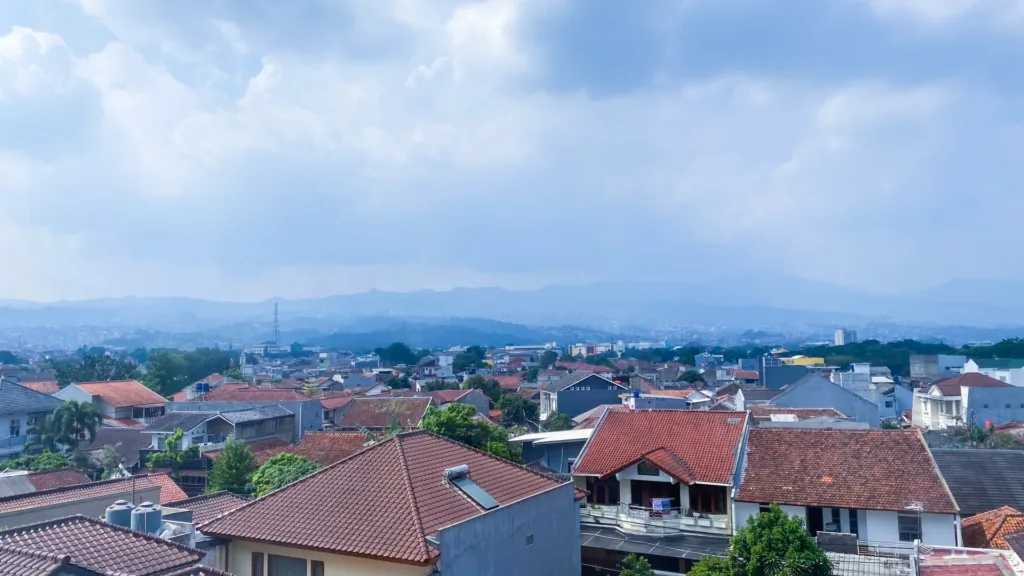
A residential district in Bandung, Indonesia — illustration. E33E asks for at least US$50,000 kept in the applicant’s own account at a state-owned bank.
Both retirement codes ask for at least US$3,000 a month; the five-year one adds at least US$50,000 in the applicant's own account at a state-owned bank, proved within 90 days of entry and kept there.
Indonesia’s immigration service publishes a page for each visa code in its index, and two of them cover retirement. E33F allows a stay of one year. E33E allows five, extendable so long as the total stay does not pass ten, and is open to foreigners aged 55 or more. Both pages ask, in the same words, for proof of income or an allowance of at least US$3,000 a month. What separates them is not that figure.
What the longer code adds
E33E carries a requirement it calls an immigration guarantee. The applicant files a letter committing to keep at least US$50,000, or the equivalent, in an account of their own at a state-owned bank. Within ninety days of the date of entry into Indonesia the holder must then report to the immigration office that issued the permit and produce proof that the money is in that account. And under the code’s other provisions, the value of the guarantee has to be maintained at the level committed to for as long as the residence permit is valid.
So it is not a payment. Nothing is transferred to the Indonesian state, and the US$50,000 sits outside the state charges rather than inside them. Those charges are published separately: Rp 13,000,000 for a stay of up to five years under E33E, against Rp 7,000,000 for one year under E33F. The E33E page adds that charges already paid are not refunded if the application is refused.
Sponsor, work and family differ too
The deposit is not the only difference between the two pages.
The first is the sponsor. E33F says a sponsor is required, and the sponsor rather than the applicant holds the account on the immigration portal and files the application. E33E says no sponsor is needed. The bank statement requirement moves with that: on E33F the three-month statement showing at least US$2,000 may be in the name of the foreigner or the sponsor; on E33E it must be personal.
The second is work. The E33F page lists what the holder may do — live in Indonesia and carry out activities connected with business, meetings or shopping, including inspecting goods at offices, factories or production sites, plus tourism and visiting friends and family. Working is not on that list. The E33E page lists tourism, buying goods and visiting family, and then adds work activities, study or other activities, on filing a dual-activity report with the immigration office that issued the permit; it also bars work inconsistent with the permit. What the one-year page’s list of permitted activities does not carry is a permission to work, and that is a difference in what has been published rather than a statement that the activity is barred.
The third is family. E33E says the holder may bring family to live in Indonesia, subject to immigration law. The E33F page does not address dependants living there, though it does list visiting friends or family among the permitted activities.
“Golden Visa” is a phrase in the published names
The five-year code is published as “E33E Visa Rumah Kedua Lansia Untuk 5 Tahun Golden Visa”. The one-year code is published as “E33F Visa Rumah Kedua Lansia Untuk 1 Tahun”, with nothing after it.
Across the index, the phrase is spread widely. Second home is a family of eight codes, and five carry Golden Visa in their published names: the base second-home code, the government-invited expert, the special-skills collaboration, the world figure invited by the government, and the five-year retirement code. Three do not: the world figure establishing a company, the one-year retirement code, and the remote-worker code. The phrase also appears on four investor codes and on two repatriation and ex-citizen descent codes.
What that shows is where the label is used, and no more than that. Within a single activity — living in Indonesia in retirement — it is on the longer code and not on the shorter one.
The remote-worker code sits in the same family
E33G, the remote-worker visa, is classified as a second-home code too. Its holder may live in Indonesia to carry out tasks for a company abroad. It asks for a bank account proving salary or income of at least US$60,000 a year and an employment contract with a company established outside Indonesian territory, and it allows one year at a time.
The two tests are not stated on the same basis. The retirement codes ask for income or an allowance of at least US$3,000 a month; the remote-worker code asks for salary or income of at least US$60,000 a year.
Where the pages stop
These are the immigration service’s own published pages, and they are the whole of the evidence here. The regulations that create the codes are not cited on them, and none was located in this run, so everything above is what the agency publishes rather than the text of an instrument. The figures are what the site showed on 15 September 2026; the pages carry no date of their own.
Two gaps are worth naming. E33F does not state a minimum age anywhere on its page, though its name says elderly and E33E states 55 or more. And the page that permits work on E33E says only that a dual-activity report is required; whether anything else is needed alongside it is not addressed. A reader planning around either point is planning around something these pages do not settle.
The Legation Times writes its content from published documents; nothing here is legal, tax or investment advice. Spotted an error? Send a correction request; for content rights, send a takedown request.