Citizenship by investment: can crypto assets or funds be used?
 Michael Mai
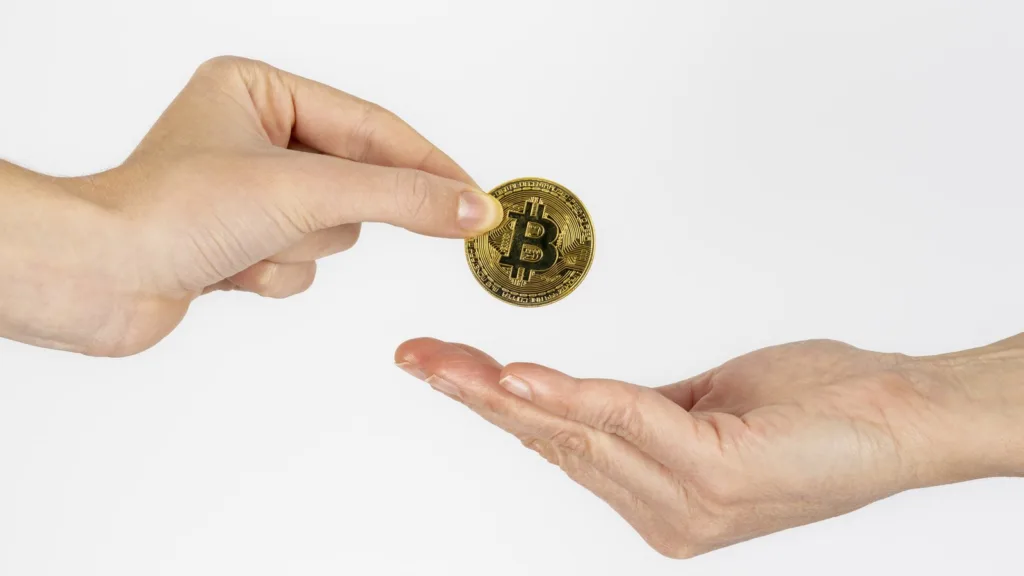
Handing over a bitcoin coin — illustration.
St Kitts and Dominica vet crypto as a source of wealth; Dominica's 2022 note wants coins sold before payment. El Salvador's portal still names bitcoin as the contribution; UAE golden visas do not cover crypto.
The two Caribbean citizenship units TLT found addressing crypto treat it as evidence of how wealth was made. St Kitts and Nevis accepts it as a partial source of wealth, with extra checks and fees, and says nothing about paying in it. Dominica asks for a sworn account of the trades and for the coins to be sold for the payment. El Salvador’s portal is the one programme checked that names crypto as the contribution.
The Caribbean: a source of wealth
The Citizenship by Investment Unit of St Kitts and Nevis says it “now accepts cryptocurrency as a partial source of wealth”. Two conditions follow on the same page: a separate proof of wealth not derived from crypto is required, and additional due diligence fees apply to this source of funds. The page does not say in what form the contribution itself is paid.
Dominica’s Citizenship by Investment Unit set out its approach in a note to agents in January 2022. Where wealth comes from crypto, the applicant must explain in a sworn affidavit how the coins were bought, their value in US dollars and how the profit was made, and confirm that they “will be liquidated in the amount required for payment of the investment”. A copy of the portfolio showing purchases and sales is also required. The same note says applicants must be able to commit to the investment and can prove it with bank statements showing enough funds; its example for a single applicant was US$100,000, a figure TLT has not checked against current thresholds. TLT has not found a later Dominican text that changes the crypto guidance.
Site searches of Antigua and Barbuda’s and Grenada’s citizenship units on 2 October returned no mention of crypto. TLT found no Vanuatu government text on crypto payment.
El Salvador: crypto as the contribution
The Salvadoran government and Tether, the issuer of the USDt stablecoin, announced the Freedom Visa on 7 December 2023, Fortune reported at the time. The government portal, adoptingelsalvador.gob.sv, sets the threshold at “$1 million in Bitcoin or USDt”, starting with a non-refundable US$999 deposit in either asset that is credited to the total once an applicant is accepted. It caps the scheme at 1,000 participants, lets a main applicant include one spouse and all children under 18 within the US$1 million, and says approvals typically take up to six weeks and a passport follows within three months.
The portal’s own questions and answers call the programme a “Bitcoin Residency Visa” in one question and “a citizenship by donation initiative” in one answer, and say successful applicants are “eligible for” a Salvadoran passport. They do not describe the legal step from visa to citizenship.
Two further points need care. On 2 October the domain answered but the page rendered blank in a browser; the terms above come from the text the site still serves. Its answers also still say bitcoin is legal tender, which predates a 2025 reform: the International Monetary Fund said in February 2025 that legal reforms had made acceptance of bitcoin by the private sector voluntary and ensured that tax payments are made only in US dollars. TLT could not establish whether applications are being processed in 2026.
The UAE: crypto investment does not qualify
On 6 July 2025 the Federal Authority for Identity, Citizenship, Customs and Port Security, the Securities and Commodities Authority and Dubai’s Virtual Assets Regulatory Authority issued a joint statement rebutting online reports that the UAE grants golden visas to crypto investors. The criteria, they said, “do not include digital currency investors”, and digital currency investments are “unrelated to golden visa eligibility”. TLT did not check how property-based or other applications are funded, or whether crypto-derived money is accepted for them.
For Vietnamese holders
In the two Caribbean programmes, the state’s questions are about the trail behind the coins, not the coins themselves: St Kitts wants wealth beyond crypto in the file, and Dominica’s 2022 note asks for the purchase history and a sale to fund the payment.
At home, Resolution 05/2025/NQ-CP allows domestic investors who hold crypto-assets, and foreign investors, to open accounts with providers licensed by the Ministry of Finance. Six months after the first licence, a domestic investor who trades crypto-assets outside a licensed provider may face administrative or criminal liability, depending on the nature and severity of the breach. The resolution also requires offering, issuance, trading and payment of crypto-assets to be in Vietnamese dong. The articles TLT reviewed do not address a sale on a foreign exchange made to fund an application abroad. TLT’s earlier report covers the pilot in more detail.
What this article does not establish
TLT checked the programmes named above, not every scheme. It did not establish whether El Salvador’s programme accepts applications in 2026, whether Dominica’s 2022 guidance still applies unchanged, or how Vietnamese foreign-exchange and outward-investment rules treat proceeds from selling crypto abroad.
The Legation Times writes its content from published documents; nothing here is legal, tax or investment advice. Spotted an error? Send a correction request; for content rights, send a takedown request.