One start-up declaration clears all three Dutch points criteria
 Edward Nguyen
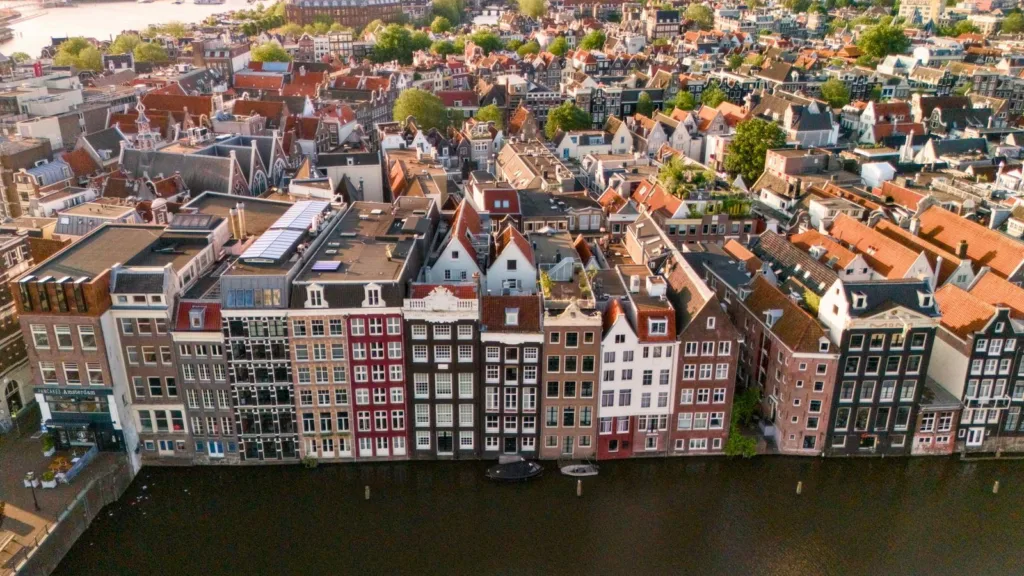
Canal houses in Amsterdam, the Netherlands — illustration. In Annex 8a, the facilitator's declaration scores 30 points under each of the three criteria.
The wealthy-foreigner residence ground closed on 17 April 2024 after fewer than ten permits in a decade; in the annex that scores the self-employed permit, capital is one input among many, not a threshold.
The Netherlands deleted its residence ground for wealthy foreign nationals on 17 April 2024. A foreigner who wants to stay on their own business activity goes instead through the self-employed permit, and the first of that permit’s three conditions is decided on points. One line, repeated in each of the scoring annex’s three criteria, carries the pass mark on all of them: a declaration from the expert facilitator who guided the applicant’s start-up track, confirming that the track was completed positively.
The ground that closed, and the date it closed on
The instrument is the decree of 9 April 2024, Staatsblad 2024, 83. Its Article V sets commencement on the day after the Staatsblad is issued, and the issue line reads “Uitgegeven de zestiende april 2024” — so 17 April 2024. The implementing circular of 24 April says it in terms: the policy “is per 17 april 2024 beëindigd”, new applications for this residence purpose are refused, and applications filed before that date are still decided under the old rules.
What went had stood since 1 October 2013. Article 3.29a allowed a permit to a foreign national holding at least €1,250,000. Later that year the policy narrowed it to investors putting that sum into an innovative enterprise, because — the explanatory memorandum records — merely holding the money was on reflection too thin a basis for a residence right. By the end the money had to reach a Dutch innovative enterprise, a partnership investing in such enterprises, or a qualifying fund, and the Netherlands Enterprise Agency had to advise that the investment carried added value.
The memorandum gives a reason and a statistic, and they are not the same thing. The reason is that schemes of this kind have been under discussion in the European Union for some years because of the risk of criminal activity such as money laundering, and that adapting this one while keeping its safeguards against abuse was not properly possible. Separately, as a fact about practice, it records that fewer than ten permits were granted on the ground in the decade it existed. Low take-up is not offered as the reason for the decision.
The legal position of existing holders is unchanged. Article IV preserves the old law for decisions already taken, for extensions of them, and for applications filed before commencement. On the strength of the permit they hold they may apply to extend or change it, or apply for a stronger right such as continued residence if they meet its conditions. What is preserved is the ability to apply, not the outcome.
What is left is tested on the plan
Two permits remain for someone arriving on their own business activity, and both sit under one restriction: arbeid als zelfstandige, work as a self-employed person.
The self-employed permit requires three things at once — work serving an essential Dutch interest, a sustainable and independent income drawn from that work, and the competence and business requirements for the activity. Only the first is decided by points, and not for everyone. Nationals of Türkiye in independent practice are assessed instead on viability, which asks whether the market allows the business to yield the entrepreneur at least the gross minimum wage; self-employed artists are assessed on the education minister’s advice. And an applicant who, when the application is received, has seven unbroken years aboard seagoing vessels entitled to fly the Kingdom’s flag, on the Dutch continental shelf, in international inland shipping aboard Dutch vessels, or in international road transport for a Dutch employer, cannot be refused for want of an essential Dutch interest.
For everyone else, Annex 8a to the Aliens Regulation 2000 scores personal experience, the business plan, and added value for the Dutch economy, and the applicant needs 30 points on each. The annex sets one alternative inside its own scoring: below 30 on added value still passes where experience and plan each reach 45.
The start-up permit is the other door, and it is not a separate purpose. It goes, by derogation, to someone founding an innovative enterprise who has sustainable means and makes it plausible that within a year they will meet the self-employed conditions. It runs for at most one year and cannot be renewed as a start-up permit — the fee schedule shows the same shape from the other side, listing a first application and a change of residence purpose, and no extension line.
The gatekeeper is a facilitator. Residence on this basis is possible only where the applicant has a reliable expert facilitator, assessed by the Enterprise Agency on registration at the Chamber of Commerce, a tailored package of facilities, at least two years guiding innovative founders across at least two people, and financial soundness. The founder is tested on control of the company — a shareholder or financier alone does not qualify — and on a step plan giving their role, why the product is innovative, and the first year’s activities. Innovation needs one of three things: new to the Dutch market, new technology in production, distribution or marketing, or an innovative organisational method. The permit may be refused where founder and facilitator are blood relatives to the third degree.
The bridge is written into the annex
Each of Annex 8a’s three criteria carries the same row. A founder who holds a permit under the start-up provision, and who produces a declaration from the expert facilitator who guided them for at least three months showing that the guidance track was completed positively, is awarded 30 points. Thirty is the minimum on each criterion, and the row appears under all three.
So it is the declaration that does the work, not the passage of a year. A founder whose facilitator signs it meets the pass mark on personal experience, on the business plan and on added value alike. The annex nowhere summarises this; it follows from the pass marks and the three repeated rows. The declaration must be on the model form the Enterprise Agency publishes.
The limit matters as much as the finding: points answer only the essential-Dutch-interest condition. Income and competence are judged separately, and the declaration does not carry them.
Capital is scored here and was a threshold there
These are two separate instruments, and this article does not trace how one came to sit beside the other. Read side by side, though, money is where they part. On the closed route it was the gate — €1,250,000 into a qualifying enterprise, or no permit. In the annex it is one input among many. Investment in fixed assets runs from nought points below €5,000 to 40 at €500,000 or more, to be realised within a year; job creation runs to 40 points, within eighteen months; a balance-sheet total under €5,000 scores nothing even at full solvency. Financing granted by a Dutch bank may take the full 50 points for financing without further checking.
The sums an applicant must evidence are of a different order. One permitted way of showing sustainable means as a start-up founder is a balance equal to the monthly subsistence norm multiplied by twelve. That norm, for a single person between 1 July and 31 December 2026, is €1,766.77 gross a month, which multiplies out to €21,201.24 — a figure this article calculates, because the Immigration and Naturalisation Service publishes the norm and not the product, and resets it every January and July. The money may sit in the founder’s Dutch account or in the facilitator’s, and means may instead be shown for a shorter intended stay or funded by another person, though periodic payments count only where the payment stream is sufficiently certain. The self-employed applicant shows €1,766.77 a month in gross profit over the same window.
Fees are set for the calendar year. In 2026 a first application or change of residence purpose costs €423 on either route, as does an extension of the self-employed permit; a self-employed applicant who already holds an EU long-term residence permit from another member state pays €254, which is also the fee for a permanent residence permit.
Where the year leads
Both permits fall under a restriction absent from the decree’s list of temporary purposes, which makes the residence right non-temporary unless something else is determined when it is granted. That is not a technicality: under the Aliens Act a permanent residence application may be refused where the applicant holds a temporary right on the day it is received. The duration requirement is five consecutive years of lawful residence of the qualifying kinds, immediately before the application, and meeting it is not the same as being granted the permit — income, accurate disclosure, criminal record, national security, principal residence and civic integration are separate grounds of refusal. This article does not assess the integration requirement.
What to watch
The subsistence norms reset on 1 January and 1 July and the fees are set for the calendar year, so every euro figure in the two paragraphs above is dated and will need re-reading. The constraint that does not move is one of timing rather than capital: the start-up permit runs for a year and cannot be renewed on that basis, so on this route the declaration has to arrive inside the year. The facilitator writing it must still hold the Enterprise Agency’s approval, and that approval is re-tested once the last advice on them is more than a year old. Three things to establish before any money moves, then — whether a suitable facilitator will take the case, how recent the agency’s advice on them is, and which half-year’s subsistence norm the application will fall in.
Related programmes
The Legation Times writes its content from published documents; nothing here is legal, tax or investment advice. Spotted an error? Send a correction request; for content rights, send a takedown request.